
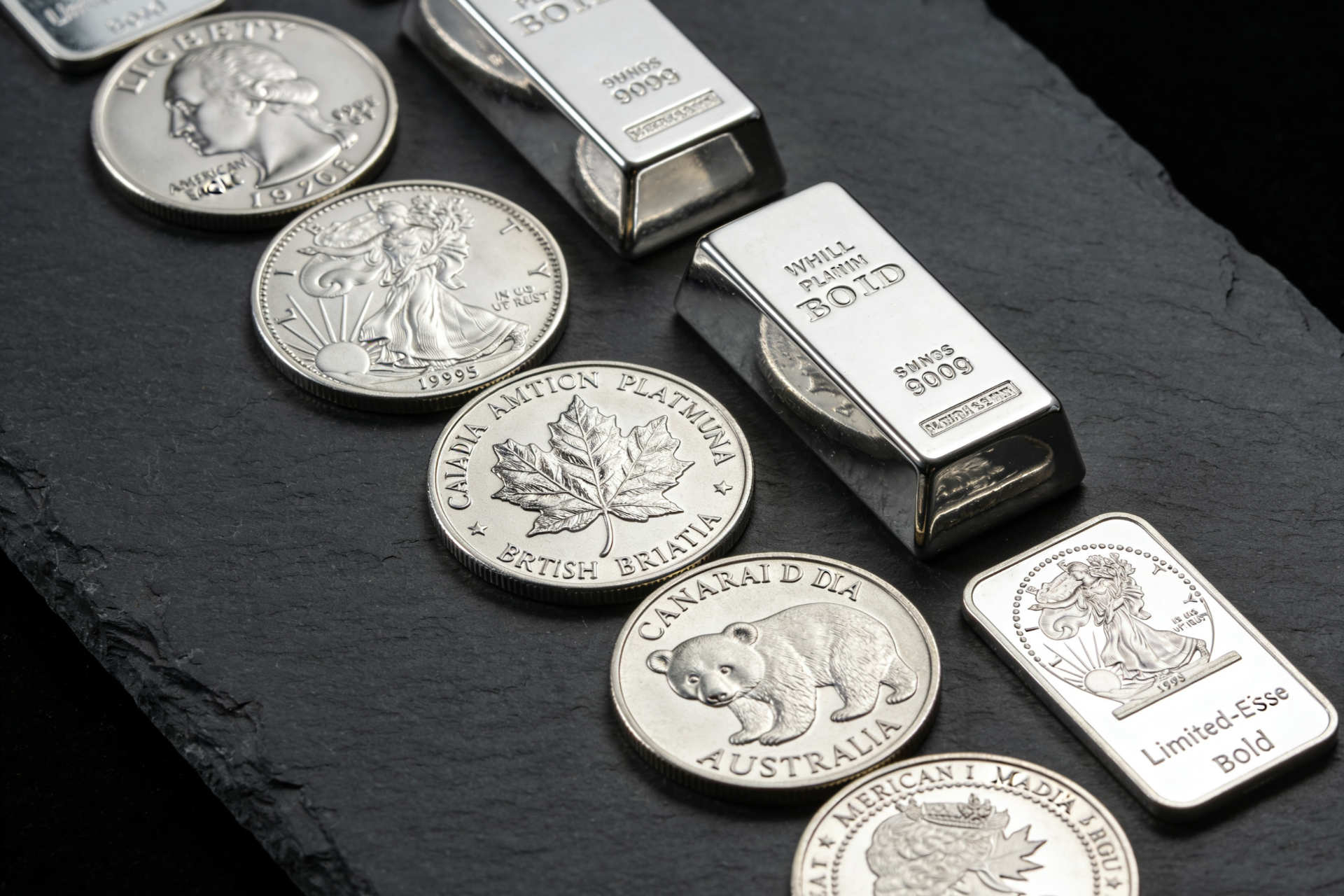
Platinum and Palladium: 0.9995 pure American Platinum Eagle, Canadian Platinum Maple Leaf, British Platinum Britannia, and Australian Platinum Koala, Canadian Palladium Maple Leaf, limited-issue American Palladium Eagles, Platinum and Palladium Bullion Bars.
Precious Metals & Investing

Gold and Silver vs. Platinum and Palladium Investing
Gold and Silver vs. Platinum and Palladium Investing

Platinum and Palladium: 0.9995 pure American Platinum Eagle, Canadian Platinum Maple Leaf, British Platinum Britannia, and Australian Platinum Koala, Canadian Palladium Maple Leaf, limited-issue American Palladium Eagles, Platinum and Palladium Bullion Bars.

Platinum and Palladium: 0.9995 pure American Platinum Eagle, Canadian Platinum Maple Leaf, British Platinum Britannia, and Australian Platinum Koala, Canadian Palladium Maple Leaf, limited-issue American Palladium Eagles, Platinum and Palladium Bullion Bars.

Key Takeaways

  • Gold and silver are monetary metals — central banks hold them, governments have used them as currency, and they have a proven track record as safe havens during economic crises.
  • Platinum and palladium are primarily industrial metals — only about 2.5% of their demand comes from investors, making them behave more like commodities than stores of value.
  • During recessions, platinum tends to fall — historical data shows it declined in the majority of U.S. recessions since 1970, while gold consistently held or gained value.
  • Silver offers a lower cost of entry than gold or platinum, making it an accessible starting point for new precious metals investors.
  • Whether platinum ever makes sense in a portfolio depends on factors most investors overlook — keep reading to find out what those are.

When it comes to precious metals investing, not all that glitters plays the same role in your portfolio.

Gold and silver have been stores of value for thousands of years. Platinum and palladium, while rare and genuinely valuable, come from an entirely different world — one driven by automotive manufacturing and industrial chemistry rather than monetary history. Understanding that distinction is the single most important thing you can do before deciding where to put your money.

Gold and Silver Win the Safe Haven Battle — Here’s Why

The term “safe haven” gets thrown around a lot in investing, but it has a specific meaning: an asset that holds or increases in value when financial markets are in turmoil. Gold has earned that title through centuries of real-world performance. Silver follows closely behind. Neither platinum nor palladium can make the same claim.

Platinum Is Rarer Than Gold, But That Doesn’t Make It a Better Investment

Platinum is genuinely scarcer than gold in the Earth’s crust, and it often carries a higher price per ounce in stable market conditions. But rarity alone doesn’t determine investment value. What matters is why people want it. If demand evaporates when the economy slows — and with platinum, it does — rarity won’t save your position. The metal’s price is tied far more to industrial output than to investor sentiment or monetary demand.

Russia's Norilsk Nickel produces around 40 percent of the world’s primary palladium, predominantly as a byproduct of nickel and copper extraction.

Only ~2.5% of Platinum and Palladium Demand Comes From Investors

This number tells you almost everything you need to know. Roughly 97.5% of platinum and palladium demand is industrial — primarily from catalytic converters in vehicles and chemical processing. Investment demand, including both physical bullion and ETF holdings, has actually been declining for several years. Compare that to gold, where investment and central bank demand represent a dominant share of the market, and the contrast becomes stark. When industrial demand drops in a recession, so does the price, with very little investor floor to catch it.

South Africa anchors the global palladium market, digging up 60 to 70 percent of the world's primary platinum from the massive Bushveld Complex.

Because there are almost no alternative mining jurisdictions that can scale to match the output of platinum and palladium, any issue at the Russian and South African sources will shift the global balance.

What Makes Gold and Silver “Monetary Metals”

Gold and silver are not just shiny commodities. They are monetary metals, which means they have historically functioned as money itself — not just as inputs for manufacturing. That distinction changes everything about how they behave in a crisis.

Central Banks Hold Gold — Not Platinum or Palladium

Central banks around the world hold gold as part of their official reserves. No major central bank holds platinum or palladium in a comparable capacity. Russia does hold platinum in its strategic state reserves, but this is an exception rather than a global standard. The fact that central banks choose gold — and have done so for centuries — is a powerful signal about which metal the world’s most sophisticated financial institutions trust as a long-term store of value.

Gold and Silver Have Functioned as Money for Thousands of Years

Gold’s role as money predates modern financial systems by millennia. Civilizations across Asia, Europe, Africa, and the Americas independently arrived at gold and silver as their preferred mediums of exchange. That kind of track record isn’t a coincidence — it reflects real properties: durability, divisibility, portability, and universal recognition. Platinum, by contrast, wasn’t even refined in significant quantities until the 18th century and never entered widespread monetary circulation.

How Gold and Silver Respond to Currency Crises

When paper currencies lose purchasing power through inflation or government mismanagement, gold and silver tend to rise. This is their core function as portfolio protection. Investors fleeing a weakening dollar, euro, or yen instinctively move toward monetary metals — not toward metals whose value depends on how many cars are being manufactured that quarter.

What Platinum and Palladium Actually Are

Platinum (Pt) and palladium (Pd) belong to the Platinum Group Metals, or PGMs. The name platinum comes from the Spanish word platina, meaning “little silver,” reflecting its silvery appearance. Both metals are rare, both are chemically stable, and both have legitimate industrial importance. The question is whether that industrial importance translates into investment value — and the honest answer is: not the way gold and silver do.

Platinum Group Metals (PGMs) and Their Industrial Role

The six Platinum Group Metals are platinum, palladium, rhodium, ruthenium, iridium, and osmium. Of these, platinum and palladium are the most commercially significant. Both are extracted primarily from mines in South Africa and Russia, with South Africa alone accounting for roughly 70% of the global platinum supply. That geographic concentration creates its own risk — supply disruptions from labor strikes or political instability can cause sharp, unpredictable price swings that have nothing to do with macroeconomic conditions or investor demand.

Why Catalytic Converters Drive Most PGM Demand

The single largest use of both platinum and palladium is in catalytic converters — the emissions-control devices fitted to gasoline and diesel engines. Palladium dominates in gasoline engines, while platinum is more commonly used in diesel applications. This means that PGM prices are deeply tied to global auto production, emissions regulations, and the long-term shift toward electric vehicles. As EV adoption accelerates, the structural demand for catalytic converters faces a real long-term headwind — a risk that simply does not exist for gold or silver in the same way.

How Platinum and Palladium Perform During Recessions

This is where the investment case for PGMs gets genuinely difficult to defend. When economies contract, industrial output falls, auto manufacturing slows, and demand for catalytic converter metals drops with it. The price follows. For an investor hoping to protect wealth during exactly those moments of economic stress, that is precisely the wrong behavior.

Platinum Fell in 6 Out of 7 U.S. Recessions Since 1970

The historical record is not kind to platinum as a crisis hedge. Looking at U.S. recessions since 1970, platinum declined in the vast majority of them. Meanwhile, gold — on average — is the only precious metal that has consistently risen during the worst stock market crashes. That pattern is not random. It reflects the fundamental difference between a monetary metal with global safe-haven demand and an industrial metal whose value depends on factory floors staying busy.

Palladium tells a similar story. Its price fell in five of the seven recessions examined, with only modest gains in the exceptions. The one standout was a double-digit rise during the 1974 recession — but a single data point over five decades is a thin foundation for a portfolio strategy. Consider how each metal has historically responded when conditions deteriorate:

  • Gold: Consistent safe-haven demand, typically holds or rises during recessions and stock market crashes

  • Silver: Follows gold with some industrial exposure, generally performs better than PGMs during downturns

  • Platinum: Declined in the majority of U.S. recessions since 1970, closely tied to industrial and auto demand

  • Palladium: Fell in five of seven recessions, with weak safe-haven credentials and high industrial dependency

The pattern becomes even clearer when you consider why recessions happen. Economic contractions reduce manufacturing, slow auto sales, and cut industrial output — all of which directly suppress PGM demand. There is no offsetting “fear premium” flowing into platinum the way it flows into gold when investors get nervous.

Investment demand for platinum and palladium has also been structurally declining. ETF holdings and physical bullion purchases in these metals have trended downward for years, which means there is less and less of an investor base to absorb selling pressure when industrial demand softens.

Why Industrial Metals Struggle When the Economy Does

The core issue is correlation. Industrial metals tend to move in the same direction as the broader economy — up when growth is strong, down when it contracts. That makes them procyclical assets. What most investors need from a precious metals allocation is something countercyclical — an asset that zigs when markets zag. Gold fills that role. Platinum largely does not.

Gold vs. Silver: Which Monetary Metal Should You Choose

Once you’ve decided to focus on monetary metals — the category where the investment case is actually strong — the next question is whether to buy gold, silver, or both. The honest answer is that they serve slightly different purposes and attract different types of buyers. Neither is universally superior; the right choice depends on your budget, your goals, and how deeply you understand each market.

Both metals share the same fundamental safe-haven credentials. Both have been used as money across cultures and centuries. Both are held outside the banking system when purchased as physical bullion, giving them a unique role as true portfolio insurance. The differences come down to price point, industrial exposure, and liquidity characteristics.

Silver Has a Lower Cost of Entry Than Gold

For investors just starting out, silver’s lower price per ounce makes it significantly more accessible. A single gold coin might cost over $2,000, while a silver coin can be purchased for well under $40. That lower barrier to entry means you can start building a physical metals position without deploying large amounts of capital upfront — and you can dollar-cost average into your position more easily over time.

Silver also has meaningful industrial demand — used in solar panels, electronics, and medical applications — which gives it an additional demand driver that pure monetary metals like gold don’t have. However, that same industrial demand means silver can be more volatile than gold during economic downturns. It is still a far stronger safe-haven asset than platinum, but investors should understand that silver is not purely a monetary metal in the same way gold is.

  • Gold: Higher cost per ounce, dominant monetary metal, held by central banks globally, least volatile of the precious metals

  • Silver: Lower cost of entry, dual monetary and industrial demand, higher volatility, stronger upside potential in bull markets

  • Platinum: Primarily industrial, no central bank demand, price tied to auto manufacturing, weaker safe-haven profile

For savers focused purely on wealth preservation, gold is typically the first choice. For those who want more potential upside and can handle greater price swings, silver offers a compelling addition to a gold position.

Diversifying Across Both Gold and Silver

Many experienced precious metals investors hold both gold and silver simultaneously, using gold as the stable anchor of their metals allocation and silver as the higher-leverage component. The two metals are positively correlated — they tend to move in the same direction — but not perfectly so, meaning silver can outperform significantly during precious metals bull markets while gold provides the floor during downturns.

Some investors let personal conviction and market knowledge guide their allocation between the two. If you follow the silver market closely and understand its industrial dynamics, a larger silver weighting might make sense. If your primary goal is capital preservation with minimal volatility, a gold-heavy allocation is more appropriate. Either way, the strategic logic of combining both metals is stronger than adding platinum or palladium to a gold-only position.

How Your Knowledge of Each Market Should Guide Your Choice

The precious metals market rewards investors who understand what they own and why they own it. If you have deep familiarity with the automotive industry, follow emissions regulations closely, and understand the supply dynamics of South African mining, platinum, or palladium might occasionally present a speculative trading opportunity. But if your goal is long-term wealth preservation — protecting purchasing power against inflation, currency debasement, or financial crisis — that expertise is better directed toward understanding gold and silver fundamentals.

The most common mistake new precious metals investors make is treating all shiny metals as interchangeable. They are not. Gold is money. Silver is money with industrial upside. Platinum and palladium are industrial inputs that happen to be expensive. Keeping that distinction clear will save you from misallocating capital into assets that behave like cyclical commodities when you need a defensive store of value most.

Should You Ever Invest in Platinum or Palladium

There are narrow scenarios where platinum or palladium exposure makes sense — but they are speculative positions, not core portfolio holdings. If you believe global auto production is about to surge, emissions regulations will tighten significantly, or supply from South African mines will be disrupted, a short-to-medium-term position in PGMs could be profitable. Some investors also hold small amounts of platinum purely for diversification across the precious metals complex, acknowledging that prices across gold, silver, and platinum are positively correlated but not perfectly so.

Platinum and palladium should never be a substitute for gold or silver in a wealth preservation strategy. The investment demand base is too thin, the industrial dependency too high, and the recession track record too weak. If you already hold a solid position in gold and silver and are looking for speculative exposure to a different part of the precious metals market, a small PGM allocation can be a calculated risk. For everyone else, the monetary metals are where the real case for investing in precious metals actually lives.

Frequently Asked Questions

Here are the most common questions investors ask when comparing gold, silver, platinum, and palladium — answered directly and without the noise.

Is Platinum a Better Investment Than Gold?

No. Despite being rarer than gold, platinum is not a better investment for most people. Its price is overwhelmingly driven by industrial demand, particularly from catalytic converters, while gold's price is supported by central bank reserves, global monetary demand, and centuries of safe-haven status. Platinum offers no meaningful floor when industrial demand collapses during a recession.

Key Comparison: Gold vs. Platinum as Investments

Gold: Held by central banks globally, a monetary safe-haven, investment demand is a primary price driver, historically rises during recessions and stock market crashes.

Platinum: No significant central bank demand, primarily industrial metal, investment demand represents only ~2.5% of total use, and historically declines during recessions.

Platinum can outperform gold during periods of strong industrial growth and tight supply, so it is not without its moments. But those moments are cyclical and speculative rather than structural. For long-term wealth preservation, gold wins decisively.

The rarity argument for platinum is real but largely irrelevant to investment performance. Markets do not reward rarity alone — they reward demand, and demand for platinum is tied to a shrinking segment of the auto industry as electric vehicles gradually reduce the need for catalytic converters.

Why Don’t Central Banks Hold Platinum or Palladium?

Central banks hold gold because it is the ultimate monetary reserve asset — universally recognized, politically neutral, and with no counterparty risk. Platinum and palladium have never played a monetary role in the modern financial system. They are industrial inputs, not monetary instruments, and central banks have no institutional reason to hold assets whose value fluctuates with auto manufacturing cycles.

Central Bank Precious Metals Holdings at a Glance

Gold: Held by nearly every major central bank worldwide as part of official reserves.

Silver: Historically held as a monetary reserve; minimal central bank holdings today, though it retains its monetary metal classification.

Platinum / Palladium: Not held as standard reserve assets by major central banks. Russia holds platinum in its strategic state reserves as a notable exception.

This distinction matters enormously for investors. Central bank demand creates a structural floor under the gold price that simply does not exist for platinum or palladium. When private investors sell gold, central banks often step in as buyers. No equivalent institutional backstop exists for PGMs.

Silver occupies an interesting middle ground. While few central banks hold silver today, it is still classified as a monetary metal due to its historical role as currency and its continued cultural and financial recognition as a store of value. That monetary heritage gives silver a different character than platinum, even though its central bank demand is also limited in the modern era.

The bottom line is that the absence of central bank demand for platinum and palladium is not an oversight — it is a deliberate reflection of what these metals actually are. Industrial commodities, however rare, are not reserve assets.

What Percentage of Platinum Demand Is From Investors?

Only roughly 2.5% of platinum and palladium demand comes from investment sources, including both physical bullion purchases and ETF holdings. The overwhelming majority — approximately 97.5% — is industrial in nature, with catalytic converters representing the single largest use case for both metals. To understand more about these metals, you can explore gold vs. silver vs. platinum vs. palladium.

That number has also been trending in the wrong direction. Investment demand for platinum and palladium has been in decline for several years, meaning the pool of buyers willing to absorb selling pressure is getting smaller, not larger. Thin investment demand means thinner liquidity and larger price swings when sentiment shifts.

Compare this to gold, where investment demand — from individual buyers, institutional funds, and central banks — represents a much larger share of total consumption. That deep, diversified investment base is precisely what gives gold its stability during periods of industrial slowdown. Silver sits between the two, with meaningful industrial demand but a far larger proportional investment base than platinum or palladium.

Can Platinum or Palladium Protect My Portfolio During a Stock Market Crash?

History says no — at least not reliably. On average, gold is the only precious metal that has consistently risen during the worst stock market crashes. Platinum and palladium, by contrast, tend to fall during market downturns because the same economic conditions that cause stock prices to drop — slowing growth, declining industrial output, reduced auto sales — also suppress demand for PGMs.

Palladium fell in five of seven U.S. recessions studied since 1970. Platinum performed similarly, declining in six of those seven recessions. The one exception for palladium — a double-digit gain during the 1974 recession — is not enough to build a reliable hedging strategy around. A single positive data point across five decades of recession history is a fragile foundation for portfolio protection.

If crisis protection is your goal, gold is the clearest answer. Silver provides meaningful protection as well, though its industrial component introduces more volatility. Platinum and palladium should not be relied upon as defensive positions during periods of market stress — the data simply does not support that role for them.

What Is the Safest Precious Metal to Invest In?

Gold is the safest precious metal for wealth preservation. It has the deepest investment demand, the longest monetary track record, central bank backing, and the strongest historical performance during recessions and financial crises. No other precious metal matches all four of those criteria simultaneously.

Silver is the second strongest option, offering genuine monetary metal status, a large investment demand base, and the added benefit of a lower cost of entry. Its industrial exposure adds volatility, but it remains far more defensive than platinum or palladium during downturns. For investors who want both stability and upside potential, a combination of gold and silver is a well-supported strategy.

Platinum and palladium are best understood as speculative positions rather than safe investments. Their prices are cyclical, their investment demand is thin and declining, and their historical performance during economic stress is poor. They may have a role in a portfolio for experienced investors making specific, short-term bets on industrial demand or supply disruptions — but not as core wealth preservation holdings.


Read More
The 5 Rules for Overcoming Investing Hesitation
Investing

The 5 Rules for Overcoming Investing Hesitation


The 5 Rules for Overcoming Investing Hesitation

The 5 Rules for Overcoming Investing Hesitation

Rule 1 for Overcoming Investing Hesitation: Reframing Loss in Investing

Human brains do not process gains and losses symmetrically.

Research in behavioral economics (Kahneman & Tversky’s prospect theory) consistently shows that the pain of losing a given sum feels roughly twice as intense as the pleasure of gaining the same amount.

This isn’t irrationality — it’s a deeply wired survival mechanism.

The problem is that it was designed for a world where losses were immediate and physical, not abstract and probabilistic.

When applied to investing, this wiring produces a specific distortion:

People overvalue the vividness of a potential loss against the invisibility of a forgone gain.

The Three Reframes that Actually Work

1. Make the invisible loss visible

Inflation is the cleanest example. Money sitting in a typical current account loses purchasing power every year — quietly, without a red number appearing anywhere.

If you reframe that as a guaranteed annual loss of 2–4% (depending on the inflation environment), the “safe” option no longer feels safe.

The loss was always there; it just wasn’t labelled as one.

2. Zoom the time axis out

Short-term market drawdowns feel catastrophic because they’re vivid and immediate. Extending the mental time horizon — looking at rolling 10 or 15-year return windows across most major markets — recontextualizes those drawdowns as temporary features of a generally upward trajectory.

This doesn’t eliminate risk, but it reframes which loss poses the greater threat: the temporary paper loss or the permanent loss of decades of compounding.

3. Separate loss of capital from loss of purchasing power over a lifetime

These are different beasts. A portfolio down 20% in a given year is distressing. Arriving at retirement with 40% less real wealth than you could have had — because you stayed out of markets for 30 years — is a far larger loss, and one with no recovery mechanism.

The first loss is recoverable.

The second isn’t.

The Practical Exercise

Write down two numbers:

  • The maximum amount you could realistically lose on an investment you’re considering, in a bad year.
  • The total amount you’d forgo in likely returns over 10 years by not investing.

For most people considering their first step, that second number is significantly larger — and far less emotionally vivid.

The exercise makes the comparison concrete, which is the only way the brain treats it seriously.

What this Reframe Doesn’t Do

It doesn’t eliminate risk or make losses painless when they happen. Markets do fall, and real money does temporarily disappear from statements.

The goal isn’t to feel nothing — it’s to hold a more accurate accounting of all the losses in play, not just the ones with obvious price tags.

The shift from “investing is where I might lose money” to “not investing is also a way of losing money” is subtle in language but significant in the decisions it produces.

Rule 2 for Overcoming Investing Hesitation: How to Stop Trying to Time the Market

This is where most hesitant investors get stuck longest — because timing feels like prudence. It feels like you’re being careful rather than paralyzed. That’s what makes it so sticky.

Why Timing Feels Rational but Isn’t

The timing impulse comes from a coherent-sounding logic: “If I just wait for a clearer picture, I’ll enter at a better point.”

The problem is that a clearer picture never actually arrives. Every moment in markets has genuine uncertainty — there’s always a credible reason to wait.

A pending election, an interest rate decision, a conflict somewhere, a valuation that looks stretched. The list regenerates endlessly.

What looks like disciplined patience is often just the brain finding new justifications for the same underlying anxiety.

The Evidence Problem

Timing requires being right twice — on the exit and the re-entry. Research on professional fund managers, who have access to resources and information that individual investors don’t, shows that consistent market timing doesn’t hold up over long periods.

The few correct calls tend to be attributed to skill; the misses tend to be rationalized away.

For individual investors, the problem compounds: people who exit markets during volatility frequently miss the sharpest recovery days, which tend to cluster right around the moments of peak fear.

Missing even a handful of the best trading days in a decade can cut long-run returns substantially.

The Structural Solution: Remove the Decision

The most durable fix isn’t psychological — it’s architectural. If the question “should I invest now?” has to be asked and answered each time, timing will creep back in.

The solution is to make the timing decision once, in advance, by setting up automatic, scheduled contributions.

This does several things at once:

  • It buys across different price points over time (often called dollar-cost averaging), which smooths the entry cost without requiring any forecasting.
  • It removes the emotional charge from each individual contribution — it just happens, like a bill payment.
  • It reframes the activity from “picking the right moment” to “maintaining a consistent behavior.”

Reframing what “Good Timing” actually means

Here’s a useful mental model: in a market that trends upward over long periods, almost any entry point looks reasonable from ten years out.

The investor who entered in early 2020 just before a sharp crash, and the investor who entered at the bottom a few weeks later, end up in roughly similar positions a decade on.

The difference that felt enormous in the moment becomes a rounding error over time.

This suggests that the real timing question isn’t “top or bottom of this cycle” — it’s “early in my investing life or late.”

On that axis, waiting is unambiguously costly, because it shortens the compounding window that drives most long-run wealth accumulation.

A Practical Circuit-breaker

When you catch yourself waiting for a better entry point, ask one question: what specific, observable condition would have to be true for me to invest?

Write it down.

Then ask whether that condition, if it arrived, would actually feel safe — or whether a new reason to wait would materialize alongside it. Most people find the answer is the latter.

That recognition, repeated a few times, tends to erode the timing impulse more effectively than any amount of abstract reasoning about market history.

The goal isn’t to stop caring about price. It’s to recognize that the cost of waiting has a price too — and unlike market movements, that cost is entirely within your control.

Rule 3 for Overcoming Investing Hesitation: What is the Right Amount to Start Investing With?

The honest answer is that the “right amount” is less a financial calculation and more a psychological calibration — and the two are often in tension.

Why the Number Matters Less Than You Think Financially

Compounding is the engine of long-term wealth accumulation, and its most important input is time, not the initial sum.

The mathematical reality is that starting with a modest amount today and adding to it consistently will, in most realistic scenarios, outperform waiting until you have a “meaningful” lump sum to deploy.

The difference between starting with $50 a month at 30 versus $500 a month at 40 is not just a factor of 10 — the decade of additional compounding on the earlier contributions does substantial independent work.

The size of the first step matters far less than the fact of taking it.

Why the Number Matters Enormously Psychologically

This is where most frameworks go wrong by skipping straight to the math.

Your first investment is not primarily a financial event.

It’s a behavioral one. It’s the moment you transition from someone who thinks about investing to someone who invests.

That transition carries emotional weight, and if the amount you commit creates anxiety — if you find yourself checking prices compulsively, catastrophizing on down days, or losing sleep — then the amount is too high for where you currently are, regardless of what the spreadsheet says.

The case for starting small is not that small amounts build wealth quickly. They don’t. The case is that a small initial position lets you experience market volatility at low emotional cost, which builds the tolerance and familiarity that makes larger future commitments sustainable.

The Three-Bracket Framework

Rather than a single number, think in terms of three brackets:

1. The learning amount — small enough that a 30% drop wouldn’t materially affect your life or cause significant stress.

For most people, this is somewhere they’d describe as “almost not worth bothering with.” That feeling is actually the point.

You want to be in markets, experiencing real movement, without the stakes being high enough to trigger reactive decisions.

2. The habit amount — a regular contribution that fits comfortably within your monthly cash flow without requiring sacrifice elsewhere.

This is what you set up on an automatic schedule.

The psychological requirement here is that it shouldn’t feel like a decision each month, just a background behavior.

3. The growth amount — what you work toward as income, confidence, and familiarity increase.

This is not a fixed target but a direction: periodically reviewing whether your contribution rate still reflects your actual financial position and risk tolerance.

Most people benefit from starting in the first bracket, moving to the second within a few months, and letting the third develop naturally over the years rather than engineering it prematurely.

The Specific Traps to Avoid

Waiting until the amount feels “worth it.” This is a moving target that tends to track anxiety rather than finances.

The amount that feels worth it tends to rise as circumstances change, which is why people who defer for size reasons often defer indefinitely.

Deploying a large lump sum before you understand how you respond to volatility.

Knowing intellectually that markets fall is different from experiencing your balance drop 15% and sitting with that.

People routinely overestimate their actual risk tolerance until they’ve lived through a real drawdown. A larger initial position before that self-knowledge exists is a setup for a panic exit at the wrong moment.

Tying the starting amount to a sense of seriousness.

There’s a cultural narrative that investing with small amounts is somehow not real investing — that you have to be playing with meaningful sums before it counts.

This is backwards. The habits, knowledge, and emotional calibration you build at a small scale are exactly what make larger-scale investing sustainable later.

The Practical Answer

Start with an amount that meets two criteria simultaneously: it’s real enough that you’ll pay attention to it, and small enough that a significant drop wouldn’t cause you genuine distress.

For most people beginning from scratch, that’s somewhere between one month’s discretionary spending and one month’s total take-home pay — but the specific number is genuinely secondary to the act of beginning.

The first contribution’s most important function is to make you an investor rather than someone planning to become one.

Rule 4 for Overcoming Investing Hesitation: How To Stay Calm When Markets Fall After Investing

The answer separates investors who build wealth over time from those who don’t.

Getting in is one hurdle.

Staying in when things turn red is the real test.

What Happens in Your Brain During a Drawdown

Market falls trigger a threat response.

When your balance drops, the brain processes it similarly to a physical danger signal — cortisol rises, attention narrows, and the urge to act becomes intense.

This is the same system that would have you pull your hand from a flame.

It’s fast, automatic, and very difficult to reason with in the moment.

The problem is that the adaptive response to financial loss — selling to stop further pain — is almost always the wrong one.

But it doesn’t feel wrong.

It feels like decisive self-protection.

Understanding that the impulse is a neurological artefact rather than sound judgement is the first layer of defense.

Why Volatility Feels Worse Than It Is

Three cognitive distortions amplify the emotional experience of a falling market:

1. Recency projection. When markets fall, the brain extrapolates the trend forward indefinitely.

A 10% drop feels like the beginning of a 50% drop, which feels like permanent loss. The historical pattern — that sharp falls are typically followed by recoveries, often faster than expected — is intellectually known but emotionally inert in the moment.

2. Loss salience. Negative price movements attract more attention than equivalent positive ones.

You’ll notice and remember a 3% down day more vividly than a 3% up day.

This means your subjective experience of investing will always feel more volatile than the actual record, because the bad days are overrepresented in memory.

3. False precision. Seeing your exact balance on a screen — down $847 from last week — gives loss a specificity that feels more real than the equivalent gain.

The number is vivid; the long-run context is abstract. Your brain treats the vivid thing as truer.

The Structural Defenses

These are things to build before markets fall, not during:

Write your investment rationale while calm.

A short document — even a few paragraphs — explaining why you invested, what your time horizon is, and what you expect markets to do periodically.

During a drawdown, reading something your past self-wrote from a position of clarity is more persuasive than trying to reason from scratch while stressed.

Set a review cadence and stick to it.

Checking your portfolio daily during volatility feeds the anxiety loop.

Deciding in advance that you’ll review quarterly — and treating mid-cycle checking as off-limits — removes the repeated exposure to red numbers that keeps the threat response activated.

Separate your investment account from your spending account mentally and practically.

Money you might need in the next two to three years shouldn’t be in volatile assets.

If it isn’t, a market fall has no practical consequence for your life right now.

Making that separation explicit — so that a falling balance genuinely doesn’t threaten anything immediate — gives the rational brain something real to hold onto.

The Reframe that Does the Most Work

A falling market is only a loss if you sell.

Until then, it’s a change in the paper valuation of assets you still own.

The units — the shares, the fund holdings — haven’t disappeared.

What’s changed is the price someone would pay for them today.

For a long-term investor who is still in the accumulation phase, a price fall is actually a mechanical positive: future contributions buy more units at lower prices.

The investor who started contributing in, say, early 2022, just before a significant correction, spent 18 months buying at reduced prices before the recovery — ending up with more units than if prices had stayed flat throughout.

This reframe doesn’t make drawdowns pleasant.

But it makes them coherent within a long-term strategy rather than evidence that something has gone wrong.

The One Question to Ask During a Fall

Has anything changed about the underlying reason I invested?

Not: Has the price changed?

Not: Is the news frightening?

But specifically, is the long-term case for being invested in diversified markets materially different from when you started?

For most people, during most market falls, the honest answer is no.

Prices are lower.

Sentiment is worse.

The fundamental logic — that productive economies generate returns over time — is unchanged.

If the answer genuinely is yes, that’s worth examining carefully.

But in most cases, asking the question precisely reveals that the discomfort is about price movement, not about the investment thesis itself.

That distinction, held clearly, is what staying calm actually looks like in practice.

Not the absence of discomfort — but the ability to act from your original reasoning rather than from the feeling that’s loudest in the moment.

Rule 5 for Overcoming Investing Hesitation: Reduce Inputs, Not Increase Them

This is really about the idea that more research past a certain threshold breeds more uncertainty, and that a deliberately constrained information diet builds more durable conviction than consuming endless financial media and analyst opinions.

This rule tends to surprise people because it runs directly against the instinct that more information equals better decisions.

In investing, that instinct is actively counterproductive past a fairly low threshold.

Why More Research Makes Decisions Harder, Not Easier

Information in financial markets has a specific property that makes it different from most other domains: it’s vast, contradictory, and almost entirely unfiltered by quality.

For every analyst arguing a market is overvalued, another is arguing the opposite — both with data, both with credentials, both with coherent-sounding logic.

When you consume enough of this material, something predictable happens.

Your brain doesn’t synthesise it into a clearer picture.

It registers the genuine disagreement among informed people and concludes that certainty is impossible, which is true, but unhelpful.

The result is that the bar for feeling “ready to invest” rises with every additional source consumed, because each new source adds a new dimension of uncertainty to track.

This is analysis paralysis in its purest form, and it’s self-reinforcing.

The more uncertain you feel, the more you research.

The more you research, the more uncertainty you find.

The Signal-To-Noise Problem In Financial Media

Financial content has a structural incentive problem.

Media needs engagement, which means drama, urgency, and strong takes.

Analysts need to say something distinctive, which means finding reasons to be either bullish or bearish rather than acknowledging that most of the time, patient participation in diversified markets is the correct answer, which is a boring sentence that nobody clicks on.

This means the information environment for individual investors is systematically biased toward the kind of content that generates anxiety and action, which are the two things long-term investors need least.

The noise isn’t random. It’s weighted toward making you feel like something requires your attention right now.

What A Constrained Information Diet Actually Looks Like

This isn’t about being uninformed; it’s about being deliberately selective.

One or two foundational sources, revisited rather than expanded.

Understanding how markets work, what diversification does, and what the long-run historical record shows is genuinely useful knowledge — and it doesn’t require constant updating, because it doesn’t change much.

Reading one good book on index investing thoroughly is worth more than a year of daily financial news.

Separating signal from noise by time horizon.

Daily and weekly market commentary is almost entirely noise for a long-term investor.

Quarterly or annual reviews of your own portfolio against your own plan — not against the market, not against what someone else is doing — is signal.

The discipline is refusing to treat the former as if it has the weight of the latter.

A written investment rationale that acts as a filter.

If a piece of information isn’t relevant to the specific reasons you invested — your time horizon, your asset allocation, your goals — it doesn’t require a response.

Having a written rationale gives you a concrete standard against which to test whether something you’ve just read actually changes anything, or just feels like it does.

The Conviction Paradox

Here’s the counterintuitive core of this rule: investors who read LESS financial news tend to hold their positions more consistently through volatility, which produces better long-run outcomes than investors who are highly informed but prone to reactive adjustments.

This isn’t because ignorance is an advantage.

It’s because consistent behaviour over time is what compounding requires, and high information consumption tends to generate high activity — and activity in investing is usually costly, both in transaction terms and in the risk of getting the timing wrong in both directions.

A conviction built on a simple, well-understood rationale is more durable than a conviction built on a complex, constantly updated model of the world.

The simple rationale doesn’t have many points of failure.

The complex one breaks every time a new piece of contradictory evidence arrives, which in financial markets is approximately daily.

The Practical Implementation

The most effective version of this isn’t white-knuckling yourself away from financial content.

It’s replacing the consumption habit with a review habit.

Instead of checking markets or reading commentary when the urge arises, schedule one deliberate review per quarter where you look at your portfolio against your plan and ask a single question: Does anything here require action based on my original rationale?

In most quarters, the answer is no.

That’s not a failure of diligence — it’s the strategy working exactly as intended.

The discipline is learning to recognise inactivity as a positive outcome rather than a sign that you’re not paying enough attention.

The investor who checks in four times a year and acts rarely will, in most realistic scenarios, outperform the investor who monitors daily and acts on what they find.

Not because they’re smarter, but because they’ve structured their behaviour to work with compounding rather than against it.

Home | PM&I

Read More
Noble Gold vs. American Hartford Gold review
Retirement Planning

Noble Gold vs. American Hartford Gold Review


Noble Gold vs. American Hartford Gold Review

Noble Gold vs. American Hartford Gold review
Noble Gold vs. American Hartford Gold Review
  • Noble Gold and American Hartford Gold are two of the most recognized Gold IRA companies, but they serve slightly different investor profiles — knowing the difference can save you thousands.
  • American Hartford Gold requires a $10,000 minimum investment, while Noble Gold’s entry point starts at just $2,000, making Noble Gold more accessible for first-time investors.
  • Both companies offer IRS-approved precious metals IRAs, buyback programs, and segregated storage — but their fee structures, metals selection, and unique perks differ in ways that matter.
  • American Hartford Gold has earned an A+ rating with the BBB and has been ranked the #1 Gold IRA company by Inc. 5000, signaling strong industry credibility.
  • Keep reading to find out which company wins on fees, customer support, and beginner-friendliness — the answer may surprise you.

Two Gold IRA Giants, One Clear Winner

Choosing the wrong Gold IRA company can cost you in fees, poor service, and missed opportunities — so getting this comparison right matters. Noble Gold Investments and American Hartford Gold are two of the most frequently compared precious metals companies in the U.S., and for good reason. Both have strong reputations, verified customer reviews, and legitimate IRS-compliant IRA products. But they are not the same company, and they are not built for the same investor.

This review breaks down exactly how these two companies compare across every metric that matters: fees, minimums, storage, metals selection, customer service, and unique features. Whether you are a first-time buyer or a seasoned investor looking to roll over a 401(k) into a Gold IRA, the details in this comparison will help you make a clear, informed decision.

What Both Companies Actually Do

Both Noble Gold and American Hartford Gold operate as precious metals dealers that specialize in self-directed IRAs backed by physical gold, silver, platinum, and palladium. In plain terms, they help you move money from a traditional retirement account — like a 401(k) or existing IRA — into an account that holds real, tangible precious metals instead of stocks or bonds. This type of account is commonly called a Gold IRA or Precious Metals IRA.

The IRS has strict rules about which metals qualify, how they must be stored, and which custodians can manage these accounts. Neither Noble Gold nor American Hartford Gold acts as the custodian themselves — instead, they work with IRS-approved third-party custodians and depositories on your behalf. What they provide is the guidance, the metals sourcing, the paperwork support, and the ongoing customer relationship.

Here is a quick overview of what both companies offer:

  • Self-directed Gold and Precious Metals IRAs (Traditional, Roth, SEP, SIMPLE)
  • 401(k) and existing IRA rollover assistance
  • Direct purchase of physical gold, silver, platinum, and palladium
  • IRS-approved storage through third-party depositories
  • Buyback programs that allow you to liquidate metals when needed
  • Educational resources for new and experienced investors

The Fastest Way to Tell Them Apart

If you need a one-sentence answer: Noble Gold is better for low-minimum, beginner-friendly investing, while American Hartford Gold is better for investors who want a high-service, high-reputation firm with a proven track record at larger investment amounts. Noble Gold’s $2,000 minimum opens the door for investors who are just getting started, while American Hartford Gold’s $10,000 minimum signals that they are geared toward more committed investors moving larger sums.

Noble Gold: What You Need to Know

Noble Gold Investments was founded in 2016 and is headquartered in Pasadena, California. Despite being a younger company compared to some competitors, Noble Gold has built a strong reputation quickly, largely due to its approachable entry point, strong customer reviews, and a few standout product offerings you will not find elsewhere. The company was co-founded by Collin Plume and Charles Thorngren, both of whom have backgrounds in the precious metals industry.

IRA and Storage Options Noble Gold Offers

Noble Gold supports Traditional, Roth, SEP, and SIMPLE IRAs, as well as 401(k) rollovers. For storage, Noble Gold uses the International Depository Services (IDS) Group, with facilities in Delaware and Texas. The Texas storage option is a notable differentiator — many competitors only offer storage in Delaware or through Brink’s in Salt Lake City. Having a Texas-based option appeals to investors who prefer domestic storage closer to their region or who simply want geographic diversification of their holdings.

Noble Gold also offers segregated storage, meaning your metals are stored separately from other customers’ holdings rather than pooled together. Segregated storage typically costs more but provides peace of mind that the exact coins or bars you purchased are the ones being held in your name.

Fees and Minimum Investment Requirements

Noble Gold charges an $80 annual IRA management fee and a $150 annual storage fee, bringing the total recurring annual cost to $230 per year. There is also a one-time IRA setup fee of $50. The minimum investment to open a Gold IRA with Noble Gold is $2,000, which is one of the lowest in the industry and significantly more accessible than many competitors.

For direct (non-IRA) purchases of physical metals, there is no stated minimum, making Noble Gold a flexible option for investors who want to buy metals outright without the IRA structure. This matters for investors who already have their retirement accounts set and simply want to own physical gold or silver outside of a tax-advantaged wrapper.

Noble Gold’s BBB and TrustPilot Ratings

Noble Gold holds an A+ rating with the Better Business Bureau (BBB) and has earned a 4.9 out of 5 stars on Trustpilot based on hundreds of verified customer reviews. Customers frequently highlight the company’s responsive customer service team and the ease of the account setup process. On Google Reviews, the company also maintains a near-perfect rating, with reviewers noting that representatives take time to explain options without pressuring customers into decisions.

The Royal Survival Pack: A Unique Noble Gold Feature

One of the most distinctive offerings Noble Gold has is something called the Royal Survival Pack — a curated selection of physical precious metals designed to be held outside of an IRA for emergency preparedness purposes. This is not a retirement product. It is a tangible asset kit that Noble Gold markets toward investors who want immediate access to real metals in the event of an economic crisis, currency collapse, or systemic financial disruption.

The Royal Survival Pack comes in three tiers based on budget and goals. Each pack contains a mix of gold and silver coins that are globally recognized and highly liquid, meaning they can be traded or sold in virtually any market condition. Noble Gold emphasizes that these packs are meant to complement a retirement strategy, not replace it — but for investors who believe in physical asset preparedness, it is a compelling and unusual product.

Noble Gold Royal Survival Pack Overview

Pack TierContentsPurpose
Basic PackMix of silver coins and small gold coinsEntry-level emergency preparedness
Mid-Tier PackIncreased silver weight, 1 oz gold coinsModerate wealth preservation outside IRA
Premium PackHigh-value gold and silver mix, globally liquid coinsComprehensive crisis hedge and physical asset reserve

American Hartford Gold: What You Need to Know

American Hartford Gold was founded in 2015 and is based in Los Angeles, California. In less than a decade, it has grown into one of the most recognized names in the Gold IRA space, earning the title of #1 Gold IRA Company on the Inc. 5000 list — a ranking of the fastest-growing private companies in America. The company is family-owned and operated, which it credits for its strong emphasis on personalized service and long-term client relationships.

American Hartford Gold has processed over $2 billion in precious metals transactions and has thousands of verified five-star customer reviews across multiple platforms. It is frequently recommended by high-profile media figures and has been featured in outlets including Forbes and Newsmax. For investors who want to work with a company that has demonstrated scale, sustained growth, and third-party validation, American Hartford Gold presents a compelling case.

IRA and Storage Options American Hartford Gold Offers

American Hartford Gold supports Traditional, Roth, SEP, and SIMPLE IRAs, along with 401(k), 403(b), TSP, and pension rollovers. Their storage is handled through the Brink’s Global Services depository in Los Angeles and the Delaware Depository, which is one of the most widely used IRS-approved storage facilities in the country. Both locations offer fully insured, IRS-compliant storage with the option of segregated or non-segregated (commingled) vaulting, depending on your preference and budget.

What sets American Hartford Gold apart in storage is the level of insurance coverage provided. The Delaware Depository carries up to $1 billion in insurance coverage through Lloyd’s of London, which is among the highest in the industry. For investors who are moving significant sums into physical metals, that level of coverage provides meaningful protection that smaller or less established depositories simply cannot match.

Fees and Minimum Investment Requirements

American Hartford Gold’s fee structure is slightly less transparent upfront than Noble Gold’s, as exact annual fees are disclosed during the account setup consultation rather than published openly on their website. However, based on verified customer reports and third-party reviews, the annual fees typically include a custodian fee ranging from $75 to $125 per year and a storage fee of approximately $100 to $150 per year. The minimum investment to open a Gold IRA is $10,000, which is considerably higher than Noble Gold’s $2,000 entry point. For direct cash purchases outside of an IRA, the minimum is $1,500.

American Hartford Gold’s BBB and TrustPilot Ratings

American Hartford Gold holds an A+ rating with the Better Business Bureau and has earned a near-perfect 4.9 out of 5 stars on Trustpilot from thousands of verified reviews — a notably large review volume compared to most competitors in the space. On Google, the company also maintains a 4.9-star rating. Customers consistently highlight the professionalism of their account representatives, the speed of IRA rollovers, and the quality of follow-up communication after the account is opened. The sheer volume of positive reviews gives American Hartford Gold a credibility edge that is difficult to dismiss.

The Price Match Guarantee Explained

One of American Hartford Gold’s most investor-friendly policies is its Price Match Guarantee. If you find a lower price on the same IRS-approved precious metals product from a competitor, American Hartford Gold commits to matching that price. This removes one of the most common anxieties investors have when buying metals — the fear that they overpaid compared to what another company was offering.

Alongside the price match, American Hartford Gold also offers a buyback commitment with no liquidation fees. When you are ready to sell your metals back, they will buy them at competitive market prices without charging you an additional fee to exit your position. This combination of price matching on the way in and fee-free buyback on the way out creates a more transparent and investor-aligned cost structure than many competitors provide.

Noble Gold vs. American Hartford Gold: Head-to-Head

Now that we have looked at each company individually, it is time to put them side by side. The comparison below focuses on the five areas that matter most to real investors: fees, customer support, investment options, ease of use for beginners, and overall value. These are not abstract categories — each one directly affects how much money you keep, how smooth your experience is, and whether your retirement assets are truly protected.

CategoryNoble GoldAmerican Hartford Gold
Minimum Investment (IRA)$2,000$10,000
Annual IRA Fee$80$75–$125
Annual Storage Fee$150$100–$150
Setup Fee$50 (one-time)Waived for qualifying accounts
Storage LocationsDelaware, TexasDelaware, Los Angeles
BBB RatingA+A+
Trustpilot Score4.9/54.9/5
Price Match GuaranteeNoYes
Survival Pack OptionYes (Royal Survival Pack)No
Buyback ProgramYesYes (no liquidation fees)

Which Company Has Lower Fees

On paper, Noble Gold’s fees are more transparent and slightly more predictable. The flat $80 annual management fee plus $150 storage fee equals $230 per year, plus a one-time $50 setup cost. American Hartford Gold’s fees fall in a similar range but vary based on account size and custodian, landing anywhere from $175 to $275 per year in total annual costs. For smaller accounts, Noble Gold’s flat-fee model is more cost-effective. For larger accounts, American Hartford Gold’s fee structure becomes proportionally cheaper as a percentage of total assets, which is where their $10,000 minimum begins to make more sense.

Which Company Has Better Customer Support

Both companies have earned strong customer service reputations, but American Hartford Gold has a measurable edge in review volume. With thousands of Trustpilot reviews compared to Noble Gold’s hundreds, American Hartford Gold’s 4.9-star rating carries more statistical weight. Customers of American Hartford Gold frequently mention dedicated account representatives who follow up proactively — not just when a sale is being made, but throughout the life of the account.

Noble Gold’s customer service scores are equally high on a per-review basis, and many customers specifically call out how the representatives explain complex IRA rules in plain language without pushing unnecessary upsells. For first-time precious metals buyers who feel intimidated by the process, Noble Gold’s lower-pressure approach may actually create a more comfortable experience. It ultimately comes down to whether you value scale and follow-through (American Hartford Gold) or accessibility and simplicity (Noble Gold).

Which Company Offers More Investment Options

American Hartford Gold offers a broad catalog of IRS-approved gold and silver coins and bars, including the American Gold Eagle, American Gold Buffalo, Canadian Gold Maple Leaf, and Austrian Gold Philharmonic. Their silver lineup includes the American Silver Eagle, Canadian Silver Maple Leaf, and Silver Austrian Philharmonic. They also carry platinum and palladium products, though the selection in those categories is more limited compared to gold and silver.

Noble Gold matches most of these offerings and adds a few unique options, particularly in their non-IRA product lineup. Their Royal Survival Pack and ability to purchase metals for home delivery without a stated minimum give Noble Gold a slight edge for investors who want flexibility beyond the IRA structure. Noble Gold also carries rare coins as part of their catalog, which American Hartford Gold does not prominently feature — though rare coins are not IRA-eligible and carry a higher risk due to their collectible premium.

For IRA-eligible metals specifically, both companies offer comparable selections with similar quality standards. The difference becomes more apparent for investors who want to hold metals outside of an IRA, where Noble Gold’s broader non-IRA product range and lower direct purchase flexibility give it an advantage.

Which Company Is Easier for Beginners

Noble Gold wins this category clearly. The $2,000 minimum removes the financial barrier that prevents many first-time investors from getting started, and the company’s educational approach is genuinely beginner-oriented without being condescending. Their onboarding process is streamlined, their representatives are known for patient explanations, and the Royal Survival Pack gives new investors a tangible, easy-to-understand entry point into physical metals ownership. American Hartford Gold is an excellent company, but its $10,000 minimum and slightly more complex fee disclosure process can feel overwhelming for someone opening their first precious metals account.

Who Should Choose Noble Gold

Noble Gold is the stronger choice for investors who are just getting started with precious metals and do not yet have a large sum to commit. If your starting budget is between $2,000 and $9,999, Noble Gold is practically your only option among top-tier Gold IRA companies with this level of credibility. The low minimum removes the intimidation factor, and the flat annual fee structure means you always know exactly what you are paying — no surprises at the end of the year.

Noble Gold also makes sense for investors who want flexibility beyond the IRA structure. If you want to own physical gold or silver outright, outside of a retirement account, Noble Gold’s direct purchase options and the Royal Survival Pack give you meaningful choices that American Hartford Gold simply does not offer. Investors who are drawn to emergency preparedness strategies or who want to keep some metals personally accessible — rather than locked in a depository — will find Noble Gold’s product lineup more aligned with that philosophy. Additionally, if Texas-based storage matters to you for geographic or political reasons, Noble Gold is one of the few reputable companies offering that option.

Who Should Choose American Hartford Gold

American Hartford Gold is the better fit for investors who are ready to commit at least $10,000 and want to work with one of the most established, heavily reviewed companies in the Gold IRA industry. If you are rolling over a significant 401(k) or IRA balance — say, $50,000 or more — the scale, infrastructure, and billion-dollar insurance coverage at the Delaware Depository provide a level of institutional-grade protection that matches the size of the commitment. The price match guarantee also ensures you are not overpaying for your metals relative to the broader market.

American Hartford Gold is also the smarter choice for investors who prioritize long-term service relationships. Their dedicated account representative model, combined with thousands of verified five-star reviews, suggests a company that stays engaged with clients well after the initial sale. If you want a Gold IRA company that will proactively communicate with you, help you understand market changes, and be responsive when you are ready to rebalance or liquidate, American Hartford Gold’s track record supports that expectation better than most competitors in the space.

The Verdict: Which Gold IRA Company Wins

The honest answer is that neither company is universally better — they are built for different investors. But if forced to choose a single winner on overall value, reputation, and long-term reliability, American Hartford Gold edges out Noble Gold for investors with $10,000 or more to invest. The combination of an A+ BBB rating, thousands of verified reviews, a price match guarantee, no liquidation fees on buybacks, and over $2 billion in processed transactions creates a level of proven, sustained credibility that is difficult to match.

That said, Noble Gold is not a consolation prize. For investors working with smaller starting budgets or those who want the flexibility of non-IRA physical metal ownership, Noble Gold is genuinely the better option. The $2,000 minimum, transparent flat-fee structure, Texas storage availability, and the Royal Survival Pack make it a uniquely versatile company that serves a different but equally legitimate investor need.

Here is the simplest way to think about it: your investment size and goals should drive the decision, not brand recognition alone. Use the summary below to quickly identify which company fits your situation.

  • Starting budget under $10,000: Noble Gold is your best credible option at this entry level.
  • Rolling over a large retirement account ($50,000+): American Hartford Gold’s infrastructure and coverage are built for this.
  • Want physical metals outside an IRA: Noble Gold’s direct purchase flexibility and Royal Survival Pack give it a clear edge.
  • Want the lowest-pressure, most beginner-friendly experience: Noble Gold’s onboarding and educational approach win here.
  • Want a price match guarantee and fee-free buyback: American Hartford Gold is the only one of these two that offers both.
  • Want the most independently verified reputation: American Hartford Gold’s review volume and media recognition give it the credibility advantage.

Whichever company you choose, make sure you complete the full account setup process, understand the fee schedule before signing, and confirm which IRS-approved custodian will be managing your account. Both Noble Gold and American Hartford Gold are legitimate, well-rated companies — the right choice simply depends on where you are in your investment journey.

Frequently Asked Questions

These are the most common questions investors ask when comparing Noble Gold and American Hartford Gold. The answers below are based on verified, publicly available information about both companies. Each question is answered in full below, drawing on verified fee disclosures, IRS regulations, and confirmed company policies. These answers apply specifically to the two companies being compared — not the Gold IRA industry as a whole, where policies can vary significantly from one provider to the next.

Is Noble Gold or American Hartford Gold Better for a First-Time Investor?

Noble Gold is better for first-time investors. The $2,000 minimum investment is significantly more accessible than American Hartford Gold’s $10,000 threshold, and Noble Gold’s customer service model is consistently praised for its patient, low-pressure educational approach. For someone who has never opened a self-directed IRA or purchased physical precious metals before, Noble Gold’s onboarding experience reduces the learning curve considerably.

That said, if a first-time investor happens to have $10,000 or more available and is serious about building a long-term retirement strategy, American Hartford Gold’s deeper service infrastructure and price match guarantee offer compelling value even at the starting line. First-time does not always mean small budget — and for those with more to invest from the beginning, American Hartford Gold’s onboarding process is straightforward enough that the experience gap narrows significantly.

Does American Hartford Gold Have Hidden Fees?

American Hartford Gold does not have hidden fees in the traditional sense, but their fee structure is less transparent upfront than Noble Gold’s because exact annual costs are disclosed during the account consultation rather than published on their website. Based on verified customer reports, total annual costs typically fall between $175 and $275 per year, covering custodian and storage fees combined. For qualifying accounts — particularly larger investments — setup fees are often waived entirely.

The lack of public fee disclosure is a legitimate criticism, and it does require investors to have a direct conversation before knowing their exact costs. However, no verified customer reports document fees appearing after account opening that were not disclosed during setup. The price match guarantee and no-fee buyback policy further support the view that American Hartford Gold operates with investor-aligned pricing, even if the initial disclosure process could be more transparent.

Can You Hold Physical Gold at Home With Noble Gold?

IRS regulations prohibit storing IRA-held precious metals at home or in a personal safe — this applies to Noble Gold and every other Gold IRA company. All IRA metals must be stored in an IRS-approved depository. However, Noble Gold does allow customers to purchase physical gold and silver outside of an IRA for direct home delivery. Their Royal Survival Pack is specifically designed for this purpose, giving investors a way to hold tangible metals personally without the IRA structure. If home storage of physical gold is your goal, Noble Gold’s direct purchase option is the legally compliant way to achieve it.

What Is the Minimum Investment for American Hartford Gold vs. Noble Gold?

Noble Gold requires a minimum of $2,000 to open a Gold IRA, while American Hartford Gold requires a minimum of $10,000. For direct cash purchases of physical metals outside of an IRA, American Hartford Gold’s minimum drops to $1,500, and Noble Gold does not publish a stated minimum for non-IRA direct purchases. If your primary goal is opening a retirement account, Noble Gold is the more accessible starting point by a significant margin.

Are Gold IRAs Actually Worth It Compared to Traditional IRAs?

Gold IRAs serve a fundamentally different purpose than traditional IRAs. A traditional IRA holds paper assets — stocks, bonds, mutual funds — whose value is tied to market performance and corporate earnings. A Gold IRA holds physical precious metals whose value is driven by supply and demand, inflation expectations, and global economic uncertainty. Gold has historically acted as a hedge against inflation and currency devaluation, making it a strategic complement to a paper-heavy retirement portfolio rather than a direct replacement for one.

The trade-off is real: Gold IRAs typically carry higher annual fees than traditional IRAs, metals do not pay dividends or interest, and short-term price volatility in precious metals can be significant. Most financial professionals recommend allocating between 5% and 15% of a retirement portfolio to precious metals rather than converting an entire retirement account into a Gold IRA. Used in that context, a Gold IRA can meaningfully reduce overall portfolio risk without sacrificing growth potential.

FactorTraditional IRAGold IRA
Asset TypeStocks, bonds, mutual fundsPhysical gold, silver, platinum, palladium
Inflation ProtectionLimitedStrong historical hedge
Annual FeesLow (often $0–$25/year)Higher ($175–$275/year typical)
Dividend/Interest IncomeYes (via underlying assets)No
Market CorrelationHigh (moves with stock market)Low to negative (often inverse to stocks)
Storage RequirementsNone (electronic holdings)IRS-approved depository required
Recommended Portfolio AllocationCore holding (60–90%)Diversification hedge (5–15%)

The bottom line is that a Gold IRA is worth it when used strategically as part of a diversified retirement plan — not as an all-or-nothing bet on precious metals. Investors who have seen their traditional portfolios take significant losses during stock market downturns often find that even a modest allocation to gold provides meaningful stability during those periods. That real-world performance track record is what continues to drive interest in Gold IRAs, even among investors who are not ideologically committed to precious metals.

Both Noble Gold and American Hartford Gold make it relatively straightforward to add a Gold IRA to an existing retirement strategy. The key is understanding what percentage of your overall portfolio you are allocating, what your fees will be on an annual basis, and what your exit strategy looks like when you are eventually ready to liquidate. Having those three answers before you open an account — with either company — will put you in a far stronger position than most investors who start the process without them.

Home | PM&I

Read More
Noble Gold vs. Goldco review
Retirement Planning

Noble Gold vs. Goldco Review


Noble Gold vs. Goldco Review

Noble Gold vs. Goldco review

  • Goldco specializes in gold and silver IRAs with a hands-on, education-first approach and dedicated account representatives guiding you through every step of the rollover process.
  • Noble Gold covers four metals — gold, silver, platinum, and palladium — and publishes a flat annual fee of $80 plus $150 for storage, making budgeting straightforward from day one.
  • Goldco requires a $25,000 minimum to open a precious metals IRA, while Noble Gold’s lower entry point makes it more accessible for investors just getting started.
  • For most investors rolling over a 401(k) or traditional IRA, Goldco’s personalized support and deep focus on the two most popular IRA metals gives it an edge — but the details matter, and we break them down fully below.
  • Both companies use IRS-approved depositories, but their storage partners, fee structures, and service models differ in ways that can significantly affect your long-term returns and experience.

Goldco Edges Out Noble Gold for Most IRA Investors

Choosing between Goldco and Noble Gold isn’t just about picking a company — it’s about matching a provider to your specific retirement strategy, timeline, and how much hand-holding you want along the way.

Goldco, founded well before Noble Gold’s 2017 launch, has built a reputation as one of the most recognized names in the gold IRA space. Its model centers on a streamlined gold and silver focus, guided onboarding, and strong third-party ratings. Noble Gold, meanwhile, has carved out a niche for investors who want transparent flat-rate pricing and access to a broader metals menu without the minimum investment barrier that Goldco requires.

Why Goldco Wins on Personalized Guidance

Goldco’s biggest differentiator is its service model. Every client is assigned a dedicated account representative — not a call center queue — who walks you through IRA setup, rollover paperwork, metal selection, and storage logistics. That consistency matters when you’re moving a significant portion of your retirement savings.

  • A dedicated one-on-one account representative is assigned at account opening
  • Education resources provided throughout the onboarding process
  • Specialist focus on gold and silver — the two most commonly held IRA-approved metals
  • Strong third-party review scores across BBB and Trustpilot
  • Rollover support for 401(k)s, traditional IRAs, Roth IRAs, and other eligible accounts

The trade-off is that Goldco’s fees aren’t fully published upfront — they’re discussed during the onboarding conversation. For some investors, that’s a friction point. But for those prioritizing guidance over raw cost transparency, Goldco’s model consistently delivers.

Where Noble Gold Pulls Ahead on Cost and Metal Variety

Noble Gold’s flat $80 annual fee plus $150 for storage is one of the clearest pricing structures in the precious metals IRA industry. There’s no guesswork, no fee tiers based on account size, and no surprise charges buried in onboarding documents. For a first-time buyer testing the waters with a smaller allocation, that clarity has real value.

Noble Gold also supports platinum and palladium alongside gold and silver — giving portfolio-minded investors a single relationship for a broader diversification strategy. Goldco doesn’t offer those two metals within its IRA product, which is a meaningful gap if you have a specific multi-metal allocation in mind.

What Goldco Actually Offers

Goldco operates as a precious metals IRA facilitator, meaning it coordinates the process between you, a self-directed IRA custodian, and an IRS-approved depository. It doesn’t custody assets itself — instead, it manages the relationship and guides you through each step. That distinction matters for understanding who’s actually holding your metals and what fees flow from where.

Gold and Silver IRA Setup and Rollover Process

Opening a Goldco IRA involves a few clearly defined stages. The company’s account team contacts you after your initial inquiry, walks through your goals and timeline, and then begins the paperwork process with a custodian. Rollovers from existing retirement accounts are the most common entry point.

  • Step 1: Initial consultation with a Goldco account representative
  • Step 2: Selection of a self-directed IRA custodian (Goldco works with preferred partners)
  • Step 3: Completion of rollover or transfer paperwork
  • Step 4: Fund the account once the rollover clears
  • Step 5: Selecting IRS-approved gold or silver products for purchase
  • Step 6: Metals are shipped directly to a designated secure depository

The minimum metal purchase for a Goldco IRA is $25,000. That threshold positions Goldco toward investors with meaningful existing retirement balances rather than those just beginning to build wealth. The custodian charges a $50 one-time setup fee and a $30 wire transfer fee, with $100 annual maintenance on top.

Dedicated Account Representatives and Education Resources

What separates Goldco’s service model from many competitors is the consistency of contact. Rather than rotating through different agents, clients work with a single point of contact throughout onboarding and beyond. This becomes particularly valuable during a rollover — a process that can involve multiple institutions, forms, and timing windows that need to align correctly.

Goldco also provides educational materials — guides, articles, and one-on-one explanations — that walk investors through IRS rules on eligible metals, contribution limits, distribution timing, and tax treatment. For someone opening their first self-directed IRA, that context isn’t just helpful — it’s essential for avoiding costly mistakes.

Storage Partners: Delaware Depository and Brinks Global Services

Goldco works with two of the most recognized names in precious metals storage: Delaware Depository and Brinks Global Services USA. Both operate IRS-approved, fully insured facilities with independent audit processes. Delaware Depository, based in Wilmington, is one of the most frequently referenced depositories in the IRA industry and carries $1 billion in all-risk insurance coverage.

Storage PartnerLocationInsurance CoverageAudit Standards
Delaware DepositoryWilmington, DE$1 billion all-riskIndependent annual audit
Brinks Global Services USAMultiple U.S. locationsFull coverage via Lloyd’s of LondonRegular third-party verification

Both facilities offer segregated and non-segregated storage options. Segregated storage keeps your specific metals separate from other clients’ holdings — a feature worth paying for if you’re storing a significant position and want certainty about exactly what you own.

What Noble Gold Actually Offers

Noble Gold was founded in 2017 and has grown quickly by targeting a specific gap in the market: investors who want transparent, low-cost access to precious metals IRAs without a high minimum investment requirement. Its model is slightly less concierge-style than Goldco’s, but it delivers straightforward access with a broader metals menu.

Four Metals Covered: Gold, Silver, Platinum, and Palladium

Noble Gold supports all four IRS-approved precious metals for IRA inclusion. That’s a meaningful advantage for investors with a specific asset allocation strategy that extends beyond gold and silver. Platinum and palladium are industrial metals with different supply-demand dynamics than gold — adding them to a retirement account creates a different kind of diversification than simply splitting between stocks and bonds.

Flat Annual Fee of $80 Plus $150 for Storage

Noble Gold’s pricing is one of its clearest selling points. The $80 annual fee covers account maintenance regardless of account size, and the $150 storage fee is a flat rate — not a percentage of assets under custody. That structure strongly favors investors with larger account balances, since a percentage-based storage fee on a $200,000 account would far exceed $150 annually.

For a newer investor with a $20,000 to $50,000 position, the math is equally favorable. Knowing exactly what you’ll pay each year — without needing to call a representative or go through an onboarding process to get a number — removes a friction point that frustrates many first-time precious metals IRA buyers.

Side-by-Side: Fees, Metals, and Minimums

The fee and minimum comparison between Goldco and Noble Gold is where most investors make their final call. Both companies operate legitimate, well-reviewed precious metals IRA services — but the cost structures are built differently, and depending on your account size and how many metals you want access to, one will clearly serve you better than the other.

Noble Gold’s Transparent Flat-Fee Structure vs. Goldco’s Onboarding Fee Discussion

Noble Gold publishes its fees directly: $80 per year for account maintenance and $150 per year for storage — a combined $230 annually, regardless of how much you have in the account. That flat structure is rare in this industry, where many competitors charge storage fees as a percentage of assets, which can quietly eat into returns as your account grows.

Goldco takes a different approach. Fees are discussed during the onboarding conversation rather than listed on a public pricing page. Based on direct outreach and independent research, Goldco’s preferred custodian charges a $50 one-time setup fee, a $30 wire transfer fee, $100 annually for maintenance, and storage fees that vary depending on the depository and storage type selected. For larger accounts, Goldco has been known to offer storage fee waivers on qualifying cash purchases — a perk that can offset the lack of upfront pricing transparency.

Minimum Investment Requirements for Each Company

This is one of the starkest practical differences between the two companies. Goldco requires a minimum metals purchase of $25,000 to open a precious metals IRA. That immediately disqualifies Goldco for investors who are earlier in their wealth-building journey or want to start with a smaller allocation to test the asset class.

Noble Gold’s minimum is significantly lower, making it accessible to a wider range of investors — particularly those rolling over smaller retirement accounts or making an initial position in precious metals without committing a large portion of their savings. Here’s how the two stack up across key criteria:

  • Goldco minimum IRA purchase: $25,000
  • Noble Gold minimum: Lower entry point, more accessible for first-time buyers
  • Goldco annual maintenance fee: $100 (via preferred custodian)
  • Noble Gold annual maintenance fee: $80 flat
  • Goldco storage fee: Variable by depository and storage type; potential waivers on larger purchases
  • Noble Gold storage fee: $150 flat annually
  • Goldco metals offered: Gold and silver
  • Noble Gold metals offered: Gold, silver, platinum, and palladium

For investors with $100,000 or more to allocate, Goldco’s potential storage fee waivers and dedicated service model may deliver more total value than Noble Gold’s flat rate. But for accounts in the $20,000 to $75,000 range, Noble Gold’s predictable annual cost of $230 is hard to beat.

Which Fee Structure Saves You More at Different Investment Levels

At smaller account sizes, Noble Gold’s flat $230 annual fee wins almost every time. As account values climb — particularly past $100,000 — Goldco’s potential for fee incentives and its stronger service infrastructure can tip the balance. The key question to ask Goldco directly during onboarding is whether storage fee waivers apply to your specific investment amount and which depository they would use for your account.

Customer Service: Where Each Company Stands

Service quality in the precious metals IRA space isn’t just about being friendly on the phone — it’s about whether a company can accurately guide you through IRS-compliant rollovers, help you avoid disqualified metal purchases, and stay responsive when your rollover hits a delay. Both Goldco and Noble Gold perform well here, but their models differ in meaningful ways.

Goldco’s One-on-One Rollover Support Model

Goldco assigns a dedicated account representative at the start of the relationship — someone who stays with you through the entire setup and rollover process. This matters most when you’re coordinating between your existing retirement account custodian, Goldco’s preferred IRA custodian, and the depository. A single point of contact reduces the risk of miscommunication and delays that can trigger unnecessary tax events if a rollover isn’t handled within IRS timing guidelines. Clients consistently highlight this continuity in third-party reviews as one of Goldco’s strongest traits.

Noble Gold’s Straightforward Approach for First-Time Buyers

Noble Gold’s service model is designed for accessibility. The company’s representatives are described across reviews as approachable, patient, and well-suited to investors who are new to self-directed IRAs and precious metals. The onboarding process is less intensive than Goldco’s, which can feel like a relief to investors who simply want to get started without an extended consultation.

That said, Noble Gold’s lighter-touch approach may leave more experienced investors wanting deeper strategic input. If you’re rolling over a large 401(k) balance and have questions about metal allocation strategy, tax implications of different rollover structures, or how to optimize storage options, Goldco’s more comprehensive service model will likely serve you better at that level of complexity.

Reputation and Third-Party Ratings

Third-party ratings in the precious metals IRA space should be weighted carefully. Many companies in this industry have cultivated review profiles aggressively, so volume of reviews matters less than the consistency of feedback themes and the company’s responsiveness to complaints.

Both Goldco and Noble Gold maintain strong reputations, but their review profiles reflect their different service models. Goldco’s reviews frequently emphasize the quality of its account representatives and the smoothness of the rollover process. Noble Gold’s reviews tend to highlight ease of setup, pricing transparency, and the helpfulness of its customer-facing staff for newer investors.

BBB Ratings and Trustpilot Scores for Both Companies

Goldco holds an A+ rating with the Better Business Bureau and maintains strong scores on Trustpilot, with a high volume of verified reviews. Noble Gold also carries a strong BBB profile with positive consumer feedback and minimal unresolved complaints. Neither company has a pattern of regulatory actions or unresolved disputes that would raise serious concern for a prospective investor.

What Real Customer Reviews Consistently Say About Each

Reading through hundreds of verified customer reviews for both companies, clear patterns emerge that go beyond marketing language. Goldco customers repeatedly mention the same qualities: knowledgeable representatives, proactive communication during the rollover process, and a sense that the company was invested in the outcome of their account setup.

Noble Gold customers, by contrast, tend to highlight how easy and low-pressure the process felt. First-time precious metals buyers frequently describe Noble Gold as the company that “didn’t make them feel stupid” for asking basic questions — a meaningful differentiator in an industry that can sometimes feel intimidating to newcomers.

Where negative reviews exist for either company, they tend to center on communication delays during high-volume periods or confusion about custodian fees that weren’t fully clarified upfront. These aren’t unique to either company — they reflect broader industry pain points around the multi-party nature of self-directed IRA administration.

  • Goldco strengths per reviews: Dedicated reps, smooth rollovers, strong educational support, proactive follow-through
  • Noble Gold strengths per reviews: Simple onboarding, transparent pricing, patient staff for first-time buyers
  • Common complaints (both): Occasional communication delays during busy periods
  • BBB standing: Both hold strong ratings with minimal unresolved complaints

The overall picture is that both companies earn their strong reputations — but for different reasons that align closely with their target customer profiles. Goldco is built for the investor who wants a managed, guided experience. Noble Gold is built for the investor who wants simplicity and cost clarity above all else.

Red Flags to Watch for in Any Precious Metals IRA Company

Neither Goldco nor Noble Gold exhibits the warning signs that should send investors running — but it’s worth knowing what those signs look like in this industry so you can evaluate any company you’re considering.

  • Pressure tactics: Any company urging you to act immediately because of an “economic collapse” or “window closing” is prioritizing a sale over your interests
  • Numismatic coin pushing: Collectible coins are not IRA-eligible and carry massive markups — legitimate IRA companies don’t push them as retirement investments
  • No published storage partners: If a company won’t tell you where your metals will be stored, that’s a serious red flag
  • Percentage-based storage fees with no cap: These can erode returns dramatically as account values grow
  • Guaranteed returns or inflation hedging promises: Precious metals prices fluctuate — no honest company guarantees performance
  • Unresolved BBB complaints or regulatory actions: A pattern of complaints that go unanswered signals poor business practices

Both Goldco and Noble Gold are transparent about their storage partners and don’t rely on high-pressure sales tactics in their documented customer interactions. That baseline legitimacy matters when you’re evaluating a category where bad actors do exist.

Now that you have a clear picture of how both companies operate, the next step is matching that information to your specific situation — investment size, metals preference, and how much guidance you want from your provider.

Which Company Is Right for You

The honest answer is that both Goldco and Noble Gold are legitimate, well-reviewed precious metals IRA providers — but they’re built for different types of investors. The right choice depends less on which company is “better” in the abstract and more on which model matches how you invest, how much you’re starting with, and what kind of support you actually need.

Choose Goldco If You Want Hands-On Guidance With Gold and Silver

Goldco is the stronger choice if you’re rolling over a substantial retirement account balance — particularly $25,000 or more — and want a dedicated professional guiding you through every step. The assigned account representative model, combined with Goldco’s deep specialization in gold and silver, creates a focused, well-supported experience that reduces the risk of IRS compliance mistakes during the rollover process.

If your retirement strategy centers on the two most established IRA-approved metals and you want a company that will proactively communicate, educate, and follow through on your behalf, Goldco consistently delivers that experience based on verified customer feedback and its long operational track record in this space.

Choose Noble Gold If You Want Low Flat Fees and Multi-Metal Options

Noble Gold makes the most sense if cost predictability is your top priority, your starting balance is below Goldco’s $25,000 minimum, or you specifically want exposure to platinum or palladium alongside gold and silver in a single IRA relationship. The combined $230 annual flat fee — $80 for maintenance and $150 for storage — is one of the most transparent pricing structures in the industry, and it scales favorably as your account grows without percentage-based fee creep eating into your returns.

The Verdict: Goldco for Most, Noble Gold for the Cost-Conscious

For the majority of investors rolling over an existing retirement account into a precious metals IRA, Goldco’s hands-on service model, dedicated account representatives, and specialized gold and silver focus give it a meaningful edge. The higher minimum is a real barrier for some, but investors who meet it tend to find the guided experience worth it. Noble Gold earns its spot for cost-conscious investors, those just starting, and anyone who wants a straightforward multi-metal IRA without the complexity of an intensive onboarding process. Know your investment size, your preferred metals, and your appetite for guidance — and the right choice between these two becomes clear.

Frequently Asked Questions

Here are the most common questions investors ask when comparing these two companies — answered directly based on verified information from both providers.

Is Noble Gold or Goldco Better for a First-Time Gold IRA Investor?

For a first-time investor, the answer depends on your starting budget. If you have $25,000 or more and want thorough guidance through your first rollover, Goldco’s dedicated account representative model and educational resources make it the stronger choice. If you’re starting with a smaller amount or simply want a low-pressure, transparent entry point into precious metals, Noble Gold’s flat fees, accessible minimum, and patient customer service staff make it the better fit for new buyers finding their footing in the asset class.

Does Noble Gold Charge Hidden Fees Beyond the Flat $80 Annual Rate?

Noble Gold’s published fee structure is $80 annually for account maintenance and $150 annually for storage — a combined $230 per year. That flat rate applies regardless of account size, which is one of Noble Gold’s most competitive features compared to percentage-based models used by other providers in the space.

That said, there are additional one-time costs that new investors should factor in when budgeting. These typically include IRA setup fees and wire transfer fees charged by the custodian — not Noble Gold directly — which are standard across the self-directed IRA industry and not unique to Noble Gold’s platform.

To avoid surprises, ask Noble Gold during your initial consultation to provide a complete fee breakdown that includes custodian setup costs, wire fees, and any transaction fees that apply when buying or selling metals within the account. The $80 maintenance fee is legitimate and not a bait-and-switch figure — but the full all-in cost picture requires accounting for custodian-side charges as well.

  • Annual maintenance fee: $80 flat (Noble Gold)
  • Annual storage fee: $150 flat (Noble Gold)
  • One-time IRA setup fee: Charged by custodian — ask for the exact amount upfront
  • Wire transfer fee: Standard custodian fee — typically $25 to $50 per transaction
  • Transaction fees: Confirm whether buy/sell transactions within the IRA carry per-trade charges

Can You Hold Platinum or Palladium in a Goldco IRA?

No — Goldco’s precious metals IRA product is focused exclusively on gold and silver. If your investment strategy requires IRA exposure to platinum or palladium, Goldco is not the right provider for that specific need. You would need to look at Noble Gold or another multi-metal IRA provider to access all four IRS-approved precious metals within a single self-directed IRA.

It’s worth noting that the IRS does permit platinum and palladium in self-directed IRAs, provided the metals meet specific purity standards — platinum must be .9995 fine and palladium must also be .9995 fine. Noble Gold supports both metals and can help you source IRS-compliant products in those categories if multi-metal diversification is part of your retirement strategy.

How Long Does a Gold IRA Rollover Take With Goldco or Noble Gold?

Typical Gold IRA Rollover Timeline

Days 1–3: Account representative consultation, paperwork initiated, custodian account opened.

Days 4–10: Rollover or transfer request submitted to your existing retirement account custodian. Direct rollovers (custodian-to-custodian) are processed within this window in most cases.

Days 10–14: Funds received and cleared by the new self-directed IRA custodian. Metal purchase order placed once funds are confirmed available.

Days 14–21: IRS-approved metals purchased and shipped to the designated depository. Segregated or non-segregated storage confirmed and documented.

Most gold IRA rollovers complete within two to three weeks from the date paperwork is submitted, though direct rollovers — where funds move custodian-to-custodian without passing through your hands — tend to process faster and carry no IRS penalty risk. Indirect rollovers, where you receive the funds personally before depositing them into the new IRA, must be completed within 60 days to avoid taxes and early withdrawal penalties.

Goldco’s dedicated account representative model is particularly valuable during this phase. Having a single contact who knows your rollover status, can follow up with the sending custodian, and flags any document issues before they cause delays is a practical advantage that shows up most clearly during the rollover window, where timing errors have real financial consequences.

Noble Gold also guides investors through the rollover process, and its team is well-reviewed for responsiveness. The timeline is comparable to Goldco’s, assuming no complications from the sending custodian. Complex rollovers — such as those involving employer-sponsored 401(k) plans that require plan administrator sign-off — may take longer regardless of which company you use.

Are Both Goldco and Noble Gold IRS-Approved for Precious Metals IRAs?

It’s important to understand how IRS approval works in this context. Neither Goldco nor Noble Gold is ‘IRS-approved’ as a company — the IRS does not endorse or certify precious metals IRA providers. What matters for IRS compliance is that the metals held in your IRA meet specific purity standards, that the account is administered by an IRS-approved custodian, and that the metals are stored in an IRS-approved depository. Both Goldco and Noble Gold work with IRS-approved custodians and IRS-approved depositories to ensure that accounts set up through their platforms meet federal requirements. Goldco works with Delaware Depository and Brinks Global Services USA, both of which are established, IRS-compliant storage facilities. Noble Gold similarly coordinates with approved storage partners to meet IRS requirements for self-directed precious metals IRAs.

The metals themselves must meet IRS purity minimums: gold at .995 fine, silver at .999 fine, platinum at .9995 fine, and palladium at .9995 fine. Both companies source IRS-eligible products and should be able to confirm the specific coins and bars available in their IRA programs. If a company ever suggests holding collectible or numismatic coins inside an IRA, that is a compliance violation — and neither Goldco nor Noble Gold engages in that practice based on their documented product offerings.

Home | PM&I

Read More
Noble Gold vs. Augusta Precious Metals review
Retirement Planning

Noble Gold vs. Augusta Precious Metals Review


Noble Gold vs. Augusta Precious Metals Review

Noble Gold vs. Augusta Precious Metals review

  • Augusta Precious Metals requires a $50,000 minimum investment, making it best suited for serious pre-retirees with large rollovers — Noble Gold opens accounts from as little as $2,000.
  • Noble Gold’s all-in $275/year fee covers both custodian and segregated storage, while Augusta’s unbundled model ($100 custodian + $100–$150 storage) is actually cheaper at larger account sizes.
  • Only Noble Gold offers all four IRS-approved metals — gold, silver, platinum, and palladium — inside a tax-advantaged IRA account.
  • At a $100,000 account size, Augusta saves approximately $280 over 10 years compared to Noble Gold — but the gap shrinks to near-zero at $500,000+.
  • The right choice comes down to one number: your starting investment amount — and we break down exactly which company wins at every portfolio size below.

If you’re comparing Noble Gold vs. Augusta Precious Metals, the answer isn’t one-size-fits-all — it depends almost entirely on how much you’re investing and what metals you want in your portfolio.

Augusta Wins on Cost and Education, Noble Gold Wins on Access and Variety

Augusta Precious Metals and Noble Gold Investments are two of the most recognized names in the Gold IRA space, but they’re built for completely different investors. Augusta targets high-net-worth retirees who want a premium, education-heavy onboarding experience and are rolling over $50,000 or more. Noble Gold casts a much wider net — lower minimums, more metals, and a flat all-inclusive fee structure that removes the guesswork.

Neither company is objectively better. The smarter question is which one is built for your situation. To answer that, let’s start with the hard numbers.

Side-by-Side Spec Sheet: Fees, Minimums, and Metals

Before diving into nuance, here’s the full comparison in one place:

FactorAugusta Precious MetalsNoble Gold Investments
Minimum Investment$50,000$2,000–$5,000
Setup Fee$50$80
Annual Custodian Fee$100Included in flat fee
Annual Storage Fee$100–$150Included in flat fee
All-In Annual Fee$200–$250$275
Metals Offered (IRA)Gold, SilverGold, Silver, Platinum, Palladium
Storage TypeSegregatedSegregated
Primary DepositoryDelaware DepositoryIDS (Texas & Delaware)
Best For$50,000+ rolloversFirst-timers, smaller accounts, multi-metal

Setup and Annual Fee Comparison

Augusta charges a $50 one-time setup fee versus Noble Gold’s $80. On the annual side, Augusta separates its custodian fee ($100/year) from storage ($100–$150/year), which totals $200–$250 annually, depending on your storage selection. Noble Gold bundles everything into a flat $275/year after setup — one invoice, no line-item surprises.

At face value, Augusta’s unbundled model is cheaper. But the predictability of Noble Gold’s flat fee has real value for investors who don’t want to track two separate billing schedules or worry about storage fee adjustments over time.

Storage Fee Structure: Bundled vs. Unbundled

Augusta routes clients to the Delaware Depository, one of the most established IRS-approved vault facilities in the country. Noble Gold primarily uses International Depository Services (IDS), with locations in Texas and Delaware. Both offer fully segregated storage — meaning your specific coins and bars are stored separately, not commingled with other investors’ metals.

The practical difference is the billing structure. With Augusta, if storage rates change, your annual cost changes. With Noble Gold’s flat $275, you lock in a known annual number from day one — a meaningful advantage for long-term financial planning.

Metals Offered: Gold and Silver Only vs. All Four IRS-Approved Metals

This is one of the clearest differentiators between the two companies. Augusta limits its IRA-eligible offerings to gold and silver. Noble Gold carries all four IRS-approved precious metals: gold, silver, platinum, and palladium. For investors who want exposure to industrial-demand metals — platinum used in catalytic converters, palladium driven by automotive and electronics demand — Noble Gold is the only option of the two. IRS rules require platinum held in an IRA to be at least 99.95% pure, and palladium must meet the same standard.

Minimum Investment: $50,000 vs. $2,000

Augusta’s $50,000 minimum is among the highest in the mainstream Gold IRA market. Noble Gold accepts accounts starting at $2,000–$5,000, which brings it within reach of virtually any 401(k) rollover or traditional IRA transfer. If your opening balance is below $50,000, the comparison ends here — Augusta simply won’t take the account.

10-Year Cost Projection at Three Portfolio Sizes

Fee structures only tell part of the story. What actually matters is the total cost of ownership over the life of your account. The projections below use each company’s published fee schedules: Augusta at $50 setup + $100 custodian + $150 storage annually (higher end of range), and Noble Gold at $80 setup + $275 flat annually.

These numbers assume no fee changes over the period, which is a conservative assumption in Augusta’s favor since its storage fees are variable. In a rising-rate storage environment, Augusta’s total could climb higher.

$25,000 Account: Noble Gold Only, Augusta Does Not Qualify

At this account size, the comparison is one-sided. Augusta’s $50,000 minimum disqualifies them entirely. Noble Gold’s 10-year cost: $80 setup + ($275 × 10 years) = $2,830 total, representing 11.3% of the portfolio value. That’s a meaningful fee load — a reminder that smaller accounts in any Gold IRA carry proportionally higher costs, regardless of provider.

This doesn’t make Noble Gold a bad choice at $25,000 — it makes them the only choice of the two. For investors at this level, the key question is whether the diversification and inflation-hedge benefits of physical metal justify that fee percentage over a 20-year retirement horizon.

$100,000 Account: Augusta Saves Roughly $280 Over a Decade

At the $100,000 level, both companies are in play, and the numbers are close:

  • Augusta: $50 setup + ($100 custodian × 10) + ($150 storage × 10) = $2,550 over 10 years (2.55% of portfolio)
  • Noble Gold: $80 setup + ($275 × 10) = $2,830 over 10 years (2.83% of portfolio)

Augusta is cheaper by $280 over a decade — roughly $28/year. That’s real money, but it’s also less than the cost of one dinner out. At this scale, the decision probably shouldn’t hinge on fees alone. Education quality, metal selection, and customer service weight become far more important differentiators.

$500,000 Account: The Fee Gap Nearly Disappears as a Percentage

At $500,000, the absolute dollar difference between companies stays the same ($280 over 10 years), but as a percentage of portfolio, it becomes nearly invisible — 0.51% for Augusta vs. 0.57% for Noble Gold. High-net-worth investors at this level are often more focused on service quality, dedicated account management, and the educational support Augusta is known for than on a $28/year fee differential.

Education and Customer Service: Two Very Different Philosophies

Augusta’s approach: Slow down, educate first, then invest. Noble Gold’s approach: Get you into the market quickly with a straightforward process. Neither is wrong — they reflect two genuinely different investor needs.

The most underrated difference between these two companies isn’t fees or metal selection — it’s how they treat you before you hand over a single dollar. Augusta has built its entire brand around investor education. Noble Gold has built its brand around accessibility and speed. Understanding which philosophy matches your own investing style is arguably more important than any fee comparison.

Customer service models in the Gold IRA industry often look identical on paper — dedicated agents, responsive support, straightforward onboarding. What separates Augusta and Noble Gold is the depth of the pre-investment experience and what happens in the first 30 days after you open an account.

Both companies have strong third-party review profiles. Augusta consistently earns near-perfect ratings on Trustpilot and the Business Consumer Alliance. Noble Gold holds strong ratings on Google and Trustpilot as well, with reviewers frequently praising the speed and simplicity of the account-opening process. The key difference is what those reviews highlight — Augusta clients talk about feeling informed, Noble Gold clients talk about feeling taken care of quickly.

Augusta’s Harvard-Trained Economist Webinars and 1-on-1 Onboarding

Augusta offers a one-of-a-kind educational web conference hosted by a member of their economics team — a Harvard-trained economist — before any account is opened. This isn’t a sales call dressed up as education. It’s a structured session that walks prospective investors through how Gold IRAs work, IRS rules, custodian relationships, and how precious metals fit into a diversified retirement strategy.

After the web conference, Augusta assigns each new client a dedicated account manager who guides them through every step of the rollover process. This is a genuine human contact point — not a rotating call center — and reviewers consistently cite this as the primary reason they chose Augusta over competitors.

What Augusta’s educational ecosystem includes:

  • Pre-investment web conference hosted by an in-house Harvard-trained economist
  • One-on-one onboarding with a dedicated account representative
  • Ongoing access to educational resources covering IRS rules, market context, and retirement strategy
  • Transparent fee disclosure before any paperwork is signed
  • Lifetime account support — your rep stays with you, not just through setup

The trade-off is time. Augusta’s process is deliberately unhurried. If you want your rollover completed in 48 hours, Augusta is not the right fit. If you want to feel genuinely confident in every decision before your money moves, the slower pace is a feature, not a flaw.

Noble Gold’s Fast Onboarding and Royal Survival Packs

Noble Gold streamlines the account-opening process significantly. Their online account setup is straightforward, rollover paperwork is handled quickly, and their team is known for being responsive without requiring multiple educational sessions before moving forward. For investors who have already done their research — or who are transferring from another Gold IRA provider — this efficiency is genuinely valuable.

Noble Gold also offers a unique physical product called the Royal Survival Pack — a curated selection of legal tender gold and silver coins that can be delivered directly to your home for non-IRA holdings. This reflects Noble Gold’s broader positioning: they serve both IRA investors and direct precious metals buyers, giving them a more versatile product lineup than Augusta’s retirement-focused model.

Persona Matrix: Which Company Fits Your Investor Profile

Stop trying to figure out which company is universally better — that framing is the wrong question. The right question is which company was built for someone in your exact situation. Here’s how the two companies stack up across the most common investor profiles.

Best for Large Rollovers of $150,000 or More: Augusta

If you’re a pre-retiree in your late 50s or early 60s rolling over a $150,000–$500,000 401(k) into a Gold IRA, Augusta is purpose-built for you. The $50,000 minimum is a non-issue at this scale, the fee differential versus Noble Gold is negligible as a percentage of your portfolio, and the white-glove educational experience reduces the risk of costly mistakes during a high-stakes rollover. Augusta scores a 9/10 for this profile versus Noble Gold’s 7/10.

Best for First-Time Buyers and Smaller Accounts: Noble Gold

Noble Gold is the clear answer for first-time precious metals investors working with amounts below $50,000, or anyone who wants to test the Gold IRA space before making a larger commitment. The $2,000–$5,000 entry point removes the biggest barrier to getting started, and the flat $275/year fee structure means you always know exactly what you’re paying.

There’s also a psychological advantage to Noble Gold’s accessibility. Many investors who start with a $15,000–$20,000 Noble Gold account end up increasing their allocation significantly once they see how the custodian relationship works and gain confidence in the asset class. Noble Gold functions as a low-friction entry point into what is, for many people, an entirely new category of retirement asset.

Best for Platinum and Palladium Exposure: Noble Gold

This one isn’t close. Augusta simply doesn’t offer platinum or palladium inside an IRA. If your investment thesis includes exposure to industrial metals — particularly palladium, which has seen significant demand from the automotive sector — Noble Gold is your only option between the two. Both platinum and palladium must meet IRS purity standards of 99.95% to qualify for IRA holding, and Noble Gold’s inventory meets those requirements.

Best for Fee Predictability: Noble Gold

Augusta’s unbundled fee structure — separate custodian and storage line items — introduces a variable that Noble Gold’s flat fee eliminates entirely. Augusta’s storage fees currently range from $100–$150 per year, but that range can shift. Noble Gold’s $275 all-in annual fee is a fixed number you can plug directly into a 20-year retirement projection.

For investors who are meticulous about retirement planning models — running spreadsheets, stress-testing fee assumptions — the certainty of Noble Gold’s flat fee has real planning value that doesn’t show up in a simple fee comparison table.

Fee predictability also matters when your account is being managed by a financial advisor or estate planner. A single, predictable annual number is easier to model than a variable fee structure that changes based on storage rate adjustments at a third-party depository.

Investor ProfileAugusta ScoreNoble Gold ScoreWinner
Pre-retiree rolling over $150,000+ 401(k)9/107/10Augusta
First-time buyer, $10,000–$25,000N/A8/10Noble Gold
High-net-worth investor, $500,000+ allocation9/107/10Augusta
Four-metal diversifier (platinum/palladium)N/A9/10Noble Gold
Investor prioritizing fee predictability7/109/10Noble Gold
Education-first investor wants hand-holding10/107/10Augusta

IRS Compliance: What Both Companies Are Required to Do

Understanding IRS compliance requirements isn’t optional knowledge for Gold IRA investors — it’s the framework everything else sits inside. Both Augusta and Noble Gold operate within the same IRS ruleset, and neither can legally offer you a self-directed precious metals IRA without meeting specific structural requirements. What matters to you as an investor is understanding exactly what those requirements are and how each company fulfills them.

IRS-Approved Depository Requirements for Physical Metal Storage

IRS regulations prohibit Gold IRA holders from taking personal possession of their IRA metals while those metals remain inside the tax-advantaged account. All physical gold, silver, platinum, and palladium held in an IRA must be stored at an IRS-approved depository — a specialized, insured vault facility that meets the agency’s security and reporting standards. Augusta uses Delaware Depository, one of the oldest and most widely recognized IRS-approved facilities in the country. Noble Gold uses International Depository Services (IDS), with vault locations in Texas and Delaware.

Both depositories offer fully segregated storage, meaning your metals are assigned to your specific account and stored separately from other investors’ holdings. This matters at the time of distribution — when you request an in-kind distribution of physical metal, you receive your specific metals back, not a generic equivalent. Commingled storage, which some lower-cost providers offer, doesn’t provide this guarantee.

Purity Standards: Gold, Silver, Platinum, and Palladium Rules

The IRS sets strict minimum purity requirements for metals held inside a self-directed IRA. These aren’t guidelines — they’re hard thresholds, and metals that don’t meet them are disqualified from IRA holding entirely:

  • Gold: Must be 99.5% pure minimum (e.g., American Gold Eagle coins are an exception at 91.67% but are explicitly approved by the IRS)
  • Silver: Must be 99.9% pure minimum
  • Platinum: Must be 99.95% pure minimum
  • Palladium: Must be 99.95% pure minimum

Augusta’s product selection is limited to gold and silver, both of which meet IRS standards across their inventory. Noble Gold’s expanded catalog — which includes platinum and palladium — must meet the higher 99.95% purity threshold for those metals, and their IRA-eligible inventory is specifically curated to comply. If you’re purchasing platinum or palladium for an IRA holding through Noble Gold, confirm the specific product meets the IRS purity standard before completing the transaction.

Third-Party Custodian Requirements and Your Legal Protections

Neither Augusta nor Noble Gold acts as its own custodian — and that’s actually a legal requirement, not a business choice. IRS rules mandate that all self-directed IRAs, including Gold IRAs, be administered by an IRS-approved third-party custodian. Augusta works with Equity Trust Company, one of the largest self-directed IRA custodians in the country. Noble Gold works with STRATA Trust Company. Both are IRS-approved, both are regulated, and both operate independently from the precious metals dealers they partner with.

This separation is your primary legal protection as an investor. Because the custodian holds your account — not the dealer — a business failure at Augusta or Noble Gold does not legally touch your metals. Your IRA account exists at the custodian level, and your metals exist at the depository level. The dealer’s role ends after the purchase is facilitated.

Understanding this three-party structure is critical before you invest a single dollar. You are not handing money to Augusta or Noble Gold — you are directing your custodian to purchase metals through them, which are then shipped directly to your depository. You never touch the metals. The dealer never holds your account balance.

  • Custodian (Equity Trust / STRATA): Holds and administers your IRA account, handles IRS reporting, and processes distributions
  • Dealer (Augusta / Noble Gold): Sources and sells IRS-eligible metals, facilitates the purchase transaction
  • Depository (Delaware Depository / IDS): Physically stores and insures your metals, provides segregated vault space

Each of these entities is independently regulated and operates under separate contractual obligations to you. If any one of them fails, the other two continue operating with your assets intact. That structural separation is what makes a legitimate Gold IRA fundamentally different — and safer — than buying physical gold through an unregulated dealer.

Rollover Timeline: What Actually Happens Day by Day

  • Day 1–3: Account application submitted and approved by your chosen custodian (Equity Trust for Augusta, STRATA for Noble Gold). IRA account number issued.
  • Day 3–7: Rollover or transfer paperwork sent to your current 401(k) or IRA custodian. Direct rollovers (custodian-to-custodian) avoid the 60-day rule and mandatory withholding.
  • Day 7–14: Funds cleared and settled in your new self-directed IRA account. Timing varies by your originating institution — some process in days, others take up to two weeks.
  • Day 14–21: You select your metals with your dealer representative. Augusta’s process includes an educational consultation at this stage. Noble Gold can typically move faster here.
  • Day 21–28: Purchase order placed, metals sourced, and shipment arranged from dealer to your designated depository.
  • Day 28–35: Metals received, inspected, catalogued, and assigned to your segregated storage account at the depository. You receive confirmation documentation.

The full process typically runs 3–5 weeks from initial application to metals confirmed in storage, assuming no delays at the originating custodian. Augusta’s onboarding is slightly longer due to the educational web conference built into the process — typically adding 3–7 days. Noble Gold’s streamlined approach can shave that window down for investors who are ready to move quickly.

The most common delay point is the originating institution — particularly employer-sponsored 401(k) plans, which sometimes require additional verification, notarized paperwork, or plan administrator sign-off before releasing funds. Neither Augusta nor Noble Gold controls this timeline, so factor in an extra week if you’re rolling over from a corporate retirement plan rather than a traditional IRA.

One important IRS rule that applies to all rollovers: if you choose an indirect rollover — where the funds are sent to you personally before being deposited into your new IRA — you have exactly 60 days to complete the deposit or the entire amount becomes a taxable distribution. Most Gold IRA rollovers are processed as direct custodian-to-custodian transfers specifically to avoid triggering this rule.

What Happens to Your Metals If Either Company Closes

Your metals are legally yours, full stop. Because your physical gold, silver, platinum, or palladium is held at an independent, IRS-approved depository in a segregated account under your name and IRA account number — not on Augusta’s or Noble Gold’s balance sheet — a dealer closure has zero legal claim on your assets. If either company were to go out of business tomorrow, you would simply work directly with your custodian (Equity Trust or STRATA) to either appoint a new dealer for future purchases or initiate a distribution of your metals.

The depository continues storing your metals under your custodian’s direction until you provide further instructions. This is not a theoretical protection — it is how the three-party structure is legally designed to function.

Augusta or Noble Gold: The Verdict Depends on One Number

That number is your opening investment amount. If it’s below $50,000, Noble Gold is your only option between the two, and it’s a legitimate one — accessible minimums, all four IRS-approved metals, a flat fee structure, and a fast onboarding process that doesn’t require a multi-session educational commitment. If your rollover is $100,000 or more and you want a premium, education-first experience with a dedicated human contact point from day one, Augusta is worth every dollar of the marginal fee premium. At $300,000+, Augusta’s combination of white-glove service, Harvard-economist webinars, and a track record of near-perfect customer reviews makes it the dominant choice for serious pre-retirees who want to get this decision right the first time.

Frequently Asked Questions

The most common questions investors have when comparing Augusta and Noble Gold come down to cost, access, and what happens to their metals over time. Here are direct, data-backed answers to each.

Both companies are legitimate, IRS-compliant Gold IRA providers with strong third-party review profiles. The questions below aren’t about credibility — both pass that bar — they’re about which company’s specific structure fits your retirement strategy.

Is Augusta or Noble Gold cheaper over 10 years?

Augusta is cheaper at account sizes of $100,000 and above — but only by approximately $280 over a full decade, which works out to roughly $28 per year. At $500,000+, the dollar difference is the same but represents a fraction of a percentage point of your total portfolio.

The calculation uses Augusta’s $50 setup fee, $100 annual custodian fee, and $150 annual storage fee (high end of range) versus Noble Gold’s $80 setup fee and flat $275 annual fee covering both custodian and storage. Over 10 years, Augusta totals $2,550 at the $100K level versus Noble Gold’s $2,830.

At $25,000, Augusta is not available, so Noble Gold’s $2,830 over 10 years is the only number on the table. At that portfolio size, the fee load is 11.3% of total account value — a real consideration that applies to Gold IRAs broadly, not just these two providers.

The more important question is whether Augusta’s variable storage fee structure could erode that cost advantage over time. If Delaware Depository increases storage rates — which depositories can do — Augusta’s 10-year total climbs while Noble Gold’s flat $275 stays fixed.

  • $25,000: Noble Gold only — $2,830 over 10 years (Augusta unavailable)
  • $100,000: Augusta $2,550 vs. Noble Gold $2,830 — Augusta saves $280
  • $500,000: Augusta $2,550 vs. Noble Gold $2,830 — Augusta saves $280 (0.06% of portfolio)

Can I open a Gold IRA with less than $50,000?

Not with Augusta — their $50,000 minimum is a firm threshold and one of the highest in the mainstream Gold IRA market. Noble Gold accepts accounts starting at $2,000–$5,000, making them accessible to first-time investors, those testing the asset class with a partial rollover, or anyone transferring a smaller legacy IRA into physical metals.

If your available rollover or transfer amount is between $5,000 and $49,999, Noble Gold is your only realistic option between these two companies. That’s not a consolation prize — Noble Gold’s flat fee structure, four-metal selection, and straightforward onboarding make it a genuinely strong choice at any account size it accepts.

Does Noble Gold really offer platinum and palladium inside an IRA?

Yes — Noble Gold carries all four IRS-approved precious metals for IRA holding: gold, silver, platinum, and palladium. Platinum must meet a 99.95% purity minimum to qualify under IRS rules, and palladium carries the same 99.95% standard. Augusta’s IRA product menu is limited to gold and silver only. If building a diversified multi-metal IRA is part of your retirement strategy — particularly for investors who want exposure to industrial metals like palladium, which is heavily tied to automotive and electronics manufacturing demand — Noble Gold is the only option of the two that makes it possible.

Are my metals stored separately under my name at both companies?

Both Augusta and Noble Gold offer fully segregated storage — your metals are stored in a vault space assigned specifically to your account, not mixed with other investors’ holdings. Augusta uses Delaware Depository; Noble Gold uses International Depository Services (IDS) in Texas and Delaware. At the time of an in-kind distribution, you receive your specific metals back — not a fungible equivalent.

Segregated storage is the gold standard (no pun intended) in IRA metal custody. The alternative — commingled storage — pools your metals with those of other investors and assigns you a book-entry ownership share rather than specific physical holdings. Some lower-cost Gold IRA providers use commingled storage to reduce fees. Both Augusta and Noble Gold’s commitment to full segregation is a meaningful quality marker.

The depository facilities themselves are independently insured and audited. Delaware Depository carries Lloyd’s of London-backed insurance coverage. IDS facilities carry their own institutional-grade coverage. Neither depository is affiliated with the dealer or custodian, which means their insurance and security obligations run independently of any business relationship with Augusta or Noble Gold.

Practically speaking, what segregated storage means for you: your name, your IRA account number, and your specific coins or bars are documented in the depository’s inventory system from the day they arrive. You can request a holdings report from your custodian at any time, confirming the exact items held on your behalf. That level of documentation transparency is what you should demand from any Gold IRA provider you consider.

Which company is better for a $300,000 rollover from a 401(k)?

At $300,000, Augusta is the stronger choice for most investors — and the fee math is only a small part of the reason. The 10-year fee difference between Augusta ($2,550) and Noble Gold ($2,830) at this scale is negligible as a percentage of portfolio value. What actually differentiates Augusta at the $300,000 level is the quality and depth of the onboarding experience during what is, for most people, one of the largest single financial decisions of their retirement planning journey.

A $300,000 rollover from a 401(k) typically involves a direct trustee-to-trustee transfer to avoid IRS penalties and withholding rules. Augusta’s dedicated account manager, pre-investment economist webinar, and transparent fee disclosure process are specifically designed for high-stakes rollovers of this size — investors who need to feel confident every step of the way, not just get paperwork processed quickly.

That said, if your $300,000 rollover includes a strategic allocation to platinum or palladium — say, 10–15% of the total in industrial metals as a hedge against automotive or tech sector demand — Noble Gold becomes relevant despite Augusta’s overall edge. Augusta simply cannot serve that portion of your allocation inside an IRA.

The practical answer for most $300,000 rollover investors: start with Augusta for the gold and silver core of your allocation, and consider whether a secondary Noble Gold account for platinum or palladium exposure adds strategic value to your overall retirement metals position. Many serious precious metals investors hold accounts at more than one provider for exactly this reason.

Home | PM&I

Read More
Dollar vs. Gold
History of Precious Metals

The History of the Dollar vs. The Gold Ounce


Dollar vs. The Gold Ounce

Dollar vs. Gold
Dollar notes and a bar of gold. The difference in value over the years since 1971, when the gold standard was dumped, is a probable reason for the divergence in values.
  • Gold has risen from $20.67 per ounce in 1910 to over $4,700 as of 12 May 2026 — a gain of more than 227%, while the dollar’s purchasing power has collapsed over the same period.
  • The U.S. officially abandoned the gold standard in 1971 when President Nixon ended the dollar’s convertibility to gold, turning the dollar into a purely fiat currency overnight.
  • The same everyday items that cost fractions of a gold ounce in 1910 still cost roughly the same fraction in gold today — proving gold holds real value while the dollar does not.
  • Central bank policy, geopolitics, and inflation have all played major roles in driving the inverse relationship between the dollar and gold prices across decades.
  • Keep reading to find out how a simple suit, steak, and car expose just how much the dollar has quietly eroded against gold over the past century.

One number tells the whole story: in 1910, an ounce of gold cost $20.67 — today, that same ounce costs over $3,100.

That gap isn’t just a trivia fact. It’s a window into one of the most important financial relationships in modern history: the ongoing battle between the U.S. dollar and gold as measures of real value. Understanding how that relationship evolved — and why it broke — helps explain inflation, monetary policy, and why gold continues to matter in a world of digital payments and fiat money. For those who want a deeper look at how gold and the dollar have interacted over the decades, the U.S. Gold Bureau has tracked and documented this relationship with detailed historical data going back over a century.

From $20 to $2,000: What Gold Reveals About the Dollar

Gold doesn’t lie. While governments can print more dollars, mint more coins, and adjust interest rates, they cannot manufacture more gold. That fundamental scarcity is why gold has served as a financial benchmark for thousands of years — and why comparing its price against the dollar across time reveals more about the dollar’s true health than any government report.

YearGold Price Per Ounce (USD)Notable Event
1910$20.67U.S. on the gold standard
1934$35.00FDR revalues gold post-Depression
1971$40.80Nixon ended gold convertibility
1980$594.90Inflation surge, Cold War tensions
2011~$1,900.00Post-financial crisis all-time high
2026$4,707.00+Ongoing inflation and dollar uncertainty

Each jump in that table isn’t random. Every significant spike in the gold price corresponds directly to a moment of dollar weakness, monetary policy upheaval, or a crisis of confidence in U.S. financial institutions. Reading the gold price chart is, in many ways, reading the biography of the American dollar.

The relationship between the two is also inverse by nature. When the dollar strengthens, gold tends to fall in price because it becomes more expensive for foreign buyers holding other currencies. When the dollar weakens, gold climbs as investors seek a store of value that can’t be diluted by a printing press. This push-and-pull dynamic has defined global finance for well over a century.

But to understand where we are today, you have to go back to where it all started — a time when a dollar really was as good as gold, because by law, it had to be.

When the Dollar Was as Good as Gold

For most of America’s early financial history, the dollar wasn’t just compared to gold — it was gold, at least in terms of legal definition. The U.S. operated under a system where every paper dollar in circulation was backed by a fixed quantity of gold held in reserve. This wasn’t a suggestion or a policy preference. It was the law.

The Gold Standard Era and Fixed Exchange Rates

The classical gold standard, which the U.S. formally adopted under the Gold Standard Act of 1900, created a system where the value of the dollar was legally fixed to a specific weight of gold. This meant exchange rates between countries were also effectively fixed, since each nation’s currency was tied to gold at a set rate. The result was a period of remarkable monetary stability, low inflation, and predictable international trade — at least when it worked.

The downside was rigidity. When economic conditions changed rapidly — as they did during wars and financial panics — governments found themselves unable to expand the money supply quickly enough to respond. The gold standard forced discipline, but it also tied policymakers’ hands at critical moments.

Why $20.67 Per Ounce Held Firm for Decades

The price of $20.67 per ounce wasn’t arbitrary. It was set by the U.S. government and held firm through legislation. Because the dollar’s value was defined as a fixed weight of gold — specifically 23.22 grains of pure gold — the “price” of gold in dollars couldn’t move. It was a definition, not a market price. This fixed rate held essentially unchanged from the 1830s all the way through the early 1930s, a nearly 100-year stretch of gold price stability that is almost incomprehensible by modern standards.

How Everyday Prices Reflected a Stable Dollar in the 1910s

In the 1910s, a dollar carried serious weight. With gold locked at $20.67 per ounce, consumer prices across the board remained relatively stable. A new Ford Model T — a cutting-edge technological marvel of the era — sold for around $400, the equivalent of roughly 19 ounces of gold. By contrast, a comparable new vehicle today costs the equivalent of 10 to 15 ounces of gold, meaning, in gold terms, cars have actually become cheaper. This distinction matters: priced in dollars, everything looks more expensive over time. Priced in gold, the picture is far more nuanced.

The Bretton Woods Agreement Changed Everything

World War II left the global financial system in ruins. European economies were devastated, currencies were unstable, and the world desperately needed a new monetary framework to rebuild international trade. What emerged from a resort in New Hampshire in July 1944 would define the global financial order for the next three decades — and set the stage for the dollar’s eventual separation from gold.

Delegates from 44 Allied nations gathered at the Mount Washington Hotel in Bretton Woods, New Hampshire, to hammer out a new system. The U.S., holding the majority of the world’s gold reserves at the time, was in the driver’s seat. What they built was audacious in its ambition and deeply consequential in its eventual collapse.

Why the World Pegged Its Currencies to the Dollar in 1944

“The Bretton Woods system made the U.S. dollar the world’s reserve currency — every other participating nation pegged its currency to the dollar, and the dollar alone was pegged to gold at $35 per ounce.”

The logic was straightforward: the U.S. held the gold, so the dollar became the anchor. Other countries would maintain fixed exchange rates against the dollar, and the dollar would remain convertible to gold at the rate of $35 per ounce for foreign governments and central banks. This made the dollar, in effect, the world’s reserve currency — a role it retains to this day, even without the gold backing.

The International Monetary Fund (IMF) and the World Bank were both created as part of this agreement, providing the institutional infrastructure to manage the new system. Countries experiencing balance of payments difficulties could draw on IMF resources to defend their fixed exchange rates, adding a layer of stability that the pre-war system had lacked.

For more than two decades, the system worked remarkably well. Post-war reconstruction boomed, international trade expanded, and the dollar’s credibility remained unquestioned. But the arrangement contained a fatal flaw that economist Robert Triffin identified as early as 1960 — a paradox that would eventually bring the entire structure down.

Triffin’s insight, now known as the Triffin Dilemma, was this: for the dollar to function as the world’s reserve currency, the U.S. had to run persistent trade deficits to supply the world with dollars. But those deficits would eventually undermine confidence in the dollar’s gold convertibility. The more dollars the world needed, the more the promise of gold backing would strain credibility.

How the U.S. Promised to Back Every Dollar With Gold

The Bretton Woods promise was explicit: any foreign central bank could walk up to the U.S. Treasury and exchange $35 for one troy ounce of gold. This convertibility guarantee was the bedrock of the entire system’s credibility. As long as the U.S. maintained sufficient gold reserves to honor that promise, the global financial order held together. By the late 1960s, however, the combination of Great Society spending programs and the cost of the Vietnam War had dramatically expanded the supply of dollars in circulation, while U.S. gold reserves were steadily draining as foreign nations began cashing in.

Nixon’s 1971 Shock: The Day the Dollar Left Gold Behind

Dollar vs. Gold

By the summer of 1971, the math had become impossible to ignore. The U.S. was hemorrhaging gold. France, under President Georges Pompidou, had been particularly aggressive in converting dollar reserves to gold — even sending a French warship to New York to physically collect gold bars from the Federal Reserve. On August 15, 1971, President Richard Nixon went on national television and announced that the U.S. would immediately suspend the convertibility of the dollar into gold. The gold standard, in any meaningful form, was dead.

What Forced Nixon to Abandon the Gold Standard

The pressure on Nixon wasn’t political theater — it was arithmetic. By 1971, the U.S. held approximately $10 billion in gold reserves while foreign governments held over $80 billion in dollar claims. The promise to convert dollars to gold at $35 per ounce was, by that point, mathematically impossible to keep. Nixon’s hand was forced not by ideology but by a run on American gold that was accelerating by the week.

The spending pressures of the 1960s had been relentless. The Vietnam War alone cost over $840 billion in today’s dollars, and President Lyndon Johnson’s Great Society programs added enormous domestic expenditures on top of that. Rather than raise taxes to cover the gap, the government expanded the money supply — printing more dollars than gold reserves could honestly support. By the time Nixon inherited the problem, the Bretton Woods framework was already cracking at the foundation.

What Happened to Gold Prices the Moment the Peg Was Cut

The immediate effect of Nixon’s announcement was relatively contained — markets don’t always grasp the full implications of seismic shifts on day one. The official gold price was initially adjusted to $38 per ounce under the short-lived Smithsonian Agreement of December 1971, which Nixon himself called “the most significant monetary agreement in the history of the world.” That agreement lasted less than 14 months before it too collapsed.

Once the Smithsonian Agreement fell apart and the major currencies moved to floating exchange rates in 1973, gold was finally free to find its true market price. What followed was one of the most dramatic price surges in commodity history. Gold moved from $35 in 1971 to over $180 by 1974 — a gain of more than 400% in just three years.

The oil crisis of 1973, triggered by the OPEC embargo, poured fuel on the fire. Inflation spiked, confidence in the dollar eroded, and investors flooded into gold as a safe haven. The combination of a newly untethered dollar and a global energy shock created the perfect conditions for gold to reassert itself as the world’s preferred store of value.

By January 1980, gold reached a then-record high of $850 per ounce — a staggering 2,329% increase from the Bretton Woods fixed rate in less than a decade. The factors that drove that surge were a telling indictment of what happens when monetary discipline disappears:

  • Runaway inflation — U.S. inflation hit 13.5% in 1980, the highest since World War II
  • Dollar devaluation — the greenback lost purchasing power year after year through the 1970s
  • Geopolitical instability — the Soviet invasion of Afghanistan and the Iran hostage crisis drove fear-based gold buying
  • Negative real interest rates — inflation outpaced savings rates, making gold more attractive than cash deposits
  • Speculative momentum — as gold rose, more buyers entered the market, accelerating the rally

How the Dollar Became a Fiat Currency Overnight

When Nixon closed the gold window, the dollar became what economists call a fiat currency — money that has value purely because the government says it does and because people collectively agree to use it. There is no gold bar in Fort Knox backing the twenty-dollar bill in your wallet. Its value rests entirely on institutional trust, the strength of the U.S. economy, and the dollar’s dominant role in global trade, particularly in oil markets where transactions are still predominantly settled in dollars.

This shift fundamentally changed the rules of monetary policy. Without the discipline of gold convertibility, the Federal Reserve gained the ability to expand the money supply in response to economic conditions — a flexibility that has both cushioned recessions and, critics argue, enabled the long-term inflation that has steadily eroded the dollar’s purchasing power ever since 1971.

Decade-by-Decade: How the Dollar Weakened Against Gold

Tracking gold’s price decade by decade isn’t just an exercise in financial nostalgia — it’s a real-time record of how much purchasing power the dollar has quietly surrendered over time. Each era tells its own story, shaped by wars, recessions, policy decisions, and market forces. But the long-term direction of the trend is unmistakable.

1910s: Gold at $20.67 and What a Dollar Could Buy

In 1910, the dollar was a serious unit of account. With gold fixed at $20.67 per ounce by law, prices across the economy reflected that stability. A pound of steak cost roughly $0.15, a decent men’s suit ran about $10 to $15, and a year’s rent in a modest American city could be covered for under $200. In gold terms, these prices were tiny fractions of a single ounce.

The first real test of the gold standard came with World War I, when the U.S. and European nations temporarily suspended gold convertibility to finance wartime spending. Though the U.S. returned to gold after the war, the episode foreshadowed the fundamental incompatibility between unlimited government spending and a gold-backed monetary system — a tension that would grow more acute with every passing decade.

1960s: Gold at $36.50 as Consumer Prices Begin to Climb

The 1960s looked stable on the surface — gold remained close to the Bretton Woods fixed price of $35 per ounce for most of the decade. But underneath that calm, the seeds of monetary instability were being planted in earnest. The combination of Vietnam War spending and Great Society domestic programs pushed federal deficits higher, expanding the money supply at a pace that gold reserves couldn’t match. Consumer prices began their upward climb, and the dollar started losing ground in real terms even before Nixon officially ended convertibility. A man’s suit that cost $15 in 1910 now runs $50 to $75, priced in dollars, nearly five times more expensive. Priced in gold ounces, the difference was far more modest.

1980s: Gold Surges to $594.90 as Inflation Hammers the Dollar

The average gold price through the 1980s settled around $594.90 per ounce, a reflection of the era’s brutal inflationary environment. Federal Reserve Chairman Paul Volcker’s decision to raise interest rates aggressively — the federal funds rate peaked at 20% in June 1981 — eventually tamed inflation, but the damage to ordinary purchasing power had already been done. The dollar of 1980 bought significantly less than the dollar of 1970, and the gap would only widen.

1990s Through 2000s: Gold Awakens From a Long Sleep

Gold spent most of the 1990s in a prolonged slump, falling as low as $252 per ounce in 1999 as a strong dollar, rising equity markets, and low inflation made the yellow metal look like a relic. Central banks were actually selling gold reserves during this period, viewing it as an unproductive asset in an era of prosperity. But the early 2000s brought a rude awakening — the dot-com bust, the September 11 attacks, the Iraq War, and eventually the 2008 financial crisis collectively shattered confidence in financial institutions and sent gold on a decade-long bull run that took it from $252 in 1999 to nearly $1,900 by 2011.

2020s: Gold Crosses $2,000 While Dollar Purchasing Power Fades

The COVID-19 pandemic triggered the largest peacetime expansion of the U.S. money supply in history. The Federal Reserve slashed interest rates to near zero, and the U.S. government deployed trillions in stimulus spending. Gold crossed $2,000 per ounce for the first time in August 2020, a milestone that would have seemed surreal to anyone who remembered the Bretton Woods era of $35 gold. By 2024, gold was trading above $3,100 per ounce, reflecting a combination of persistent inflation, geopolitical uncertainty, and declining confidence in fiat currency stability.

The numbers below put the entire century-long journey into stark perspective:

DecadeAvg. Gold Price/ozU.S. Inflation RateDollar Purchasing Power vs. 1913
1910s$20.67~7% (WWI spike)~$1.00
1930s$33.85 (post-revaluation)Deflation then recovery~$0.70
1960s$35.27~2-3%~$0.42
1980s$594.90~7-13%~$0.18
2000s$572.00~2-3%~$0.10
2020s$4,000+~4-9%~$0.04

What that final column reveals is staggering: a dollar that was worth $1.00 in purchasing power in 1913 is worth approximately four cents in equivalent terms today. Gold, by contrast, has preserved and grown real value across every single one of those decades. That is not a coincidence — it is the mathematical consequence of a fiat monetary system operating without the anchor of a gold standard.

What a Suit, a Steak, and a Car Reveal About Dollar Erosion

Abstract monetary theory becomes concrete fast when you price everyday items in gold instead of dollars. A quality men’s suit cost roughly $20 in 1910 — nearly one full ounce of gold. Today, a comparable suit runs $400 to $600 in dollars, but still costs approximately the same fraction of a gold ounce as it did over a century ago. The steak that cost $0.15 per pound in 1910 now costs $12 to $15 per pound — a 100-fold increase in dollar terms, but a nearly identical cost when measured against gold.

The car that sold for $400 in 1910 (roughly 19 ounces of gold) now sells for $30,000 to $50,000 in dollars — but only 10 to 15 ounces of gold, meaning cars have actually gotten cheaper in real gold terms. These examples don’t just illustrate inflation. They reveal that the dollar has been the variable all along — and gold has been the constant.

How the Same Items Cost More Dollars but Fewer Gold Ounces Over Time

The most revealing way to understand dollar erosion isn’t to look at inflation charts — it’s to price ordinary goods in gold across different decades. When you do that, something remarkable happens: the gold cost of everyday items stays remarkably stable while the dollar cost explodes. A gallon of gasoline cost about $0.25 in 1950, which was roughly 0.007 ounces of gold. Today, that same gallon costs around $3.50 — but still works out to approximately 0.001 ounces of gold. In dollar terms, gas is 14 times more expensive. In gold terms, it’s actually cheaper.

This pattern repeats across nearly every major consumer category — food, housing, clothing, transportation. The dollar figures change dramatically while the gold figures remain surprisingly consistent. That consistency isn’t magic. It’s the natural result of gold’s fixed supply meeting the world’s relatively stable demand for real goods, while the dollar supply has been expanded repeatedly by policy decisions that have nothing to do with economic productivity. The suit, the steak, and the car aren’t getting more expensive in any absolute sense. The dollar measuring them is simply getting smaller.

Why Gold Measures Real Value Better Than the Dollar Alone

A ruler that keeps shrinking is a terrible measuring tool. That’s essentially what the dollar has become since 1971 — a unit of measurement that contracts in value over time, making it genuinely difficult to compare prices, wages, or wealth across decades with any accuracy. Gold, by contrast, maintains a consistent relationship with the real economy because its supply can only grow at the pace of mining output, historically around 1-2% per year — roughly in line with long-term global economic growth.

This is why economists and financial historians frequently price major historical events and assets in gold terms rather than nominal dollars. When you want to know whether housing is truly more expensive than it was in 1970, or whether wages have genuinely improved since 1980, stripping out the dollar distortion by converting to gold ounces gives you a far cleaner comparison. The dollar tells you what something costs today. Gold tells you what it’s worth in a deeper, more durable sense.

That said, gold is not a perfect measure either. It has its own supply and demand dynamics, geopolitical influences, and speculative phases that can temporarily push its price far above or below fundamental value. The 1980 spike to $850 per ounce and the subsequent crash back to $300 by 1985 is a reminder that gold can be volatile in the short term, even as it holds value over long stretches. The key is time horizon — over decades, gold has proven itself a reliable store of value in a way that no fiat currency in history has managed to sustain.

  • Gold supply grows at roughly 1-2% annually — closely matching long-term global economic growth, which underpins its stability as a value benchmark
  • The dollar has lost over 96% of its 1913 purchasing power — while gold priced in dollars has risen from $20.67 to over $3,100 in the same period
  • Everyday goods priced in gold ounces show remarkable price stability across a century, even as their dollar prices have multiplied many times over
  • Central banks worldwide still hold gold as a reserve asset — a clear institutional acknowledgment that gold retains real monetary value even in a fiat currency world
  • Gold’s 2011 all-time high of nearly $1,900 and its subsequent climb past $4,000 in 2026 both correlated directly with periods of exceptional dollar weakness and inflation. There’s likely more to this upward gold valuation than meets the eye, with the international strife since 9/11 having much to do with it

None of this means gold is a perfect investment or that a return to the gold standard is practical or even desirable, but that’s a moot point. Modern economies seem to require monetary flexibility that a rigid gold peg cannot provide. But as a measuring stick for real value — stripped of political influence, printing press distortions, and policy manipulation — gold has earned its reputation across centuries of financial history as the most honest unit of account humanity has yet devised.

Gold as the Dollar’s Report Card

Every time the gold price rises sharply, it is handing the dollar a failing grade. Every sustained surge in gold — 1971 to 1980, 1999 to 2011, 2018 to today — has coincided with a period of dollar weakness, monetary expansion, geopolitical stress, or collapsing institutional confidence. The inverse relationship is not a coincidence of markets — it is a structural feature of a world where gold remains the implicit benchmark against which all paper currencies are quietly measured.

From $20.67 in 1910 to over $3,100 today, the gold price isn’t telling you that gold has become more valuable. It’s telling you that the dollar has become less so — one decade at a time, one policy decision at a time, one printing press run at a time.

Frequently Asked Questions

The dollar vs. gold relationship spans over a century of monetary history, policy shifts, and economic upheaval. These are the questions that financial history enthusiasts most frequently ask when digging into the topic.

Understanding the answers gives you a foundation for interpreting not just history, but the financial headlines being written right now — because the same forces that drove gold from $35 to $850 in the 1970s are recognizable in the dynamics playing out in today’s markets.

Why did the U.S. abandon the gold standard?

The U.S. abandoned the gold standard because the promise of gold convertibility had become mathematically impossible to keep. By August 1971, the U.S. held approximately $10 billion in gold reserves while foreign governments held over $80 billion in convertible dollar claims. The combination of Vietnam War spending, Great Society domestic programs, and persistent trade deficits had flooded the world with far more dollars than existing gold reserves could back at the fixed rate of $35 per ounce.

President Nixon’s decision on August 15, 1971 — what became known as the Nixon Shock — was the final break. It wasn’t a planned transition to a better system. It was an emergency response to a run on American gold that was accelerating by the week, with France leading the charge by physically redeeming dollar reserves for gold bars. Once convertibility ended, the Bretton Woods system collapsed, major currencies moved to floating exchange rates by 1973, and gold was free to find its true market price for the first time in decades.

What was the price of gold per ounce in 1910?

In 1910, the price of gold was fixed at $20.67 per troy ounce. This wasn’t a market price determined by supply and demand — it was a legal definition established by the U.S. government under the gold standard. The dollar was defined as a specific weight of gold (23.22 grains of pure gold), which made $20.67 the mathematical equivalent of one troy ounce. This fixed price had held essentially unchanged since the 1830s.

That $20.67 figure held firm through World War I, the Roaring Twenties, and into the early 1930s — nearly a full century of gold price stability that is impossible to imagine by modern standards. The rate was only officially changed in 1934 when President Franklin D. Roosevelt revalued gold to $35 per ounce under the Gold Reserve Act, effectively devaluing the dollar by approximately 41% in a single policy move aimed at fighting the Great Depression.

How much has the dollar lost in value since 1971?

Since Nixon ended gold convertibility in 1971, the dollar has lost the vast majority of its purchasing power. A dollar from 1971 is worth approximately 15 to 16 cents in equivalent purchasing power today — meaning it takes roughly six to seven 2024 dollars to buy what one 1971 dollar could purchase. This represents a purchasing power loss of over 85% in just over five decades.

Gold tells the same story from the other direction. At the time of the Nixon Shock, gold was trading at around $40 to $42 per ounce in the newly freed market. By 2024, gold crossed $3,100 per ounce — an increase of roughly 7,500% from those early post-Bretton Woods prices. The dollar didn’t become worthless overnight. It eroded steadily, year after year, through the compounding effects of inflation, monetary expansion, and the structural consequence of removing the gold anchor from the world’s reserve currency.

Is gold still used to back any currencies today?

No major currency in the world today is formally backed by gold. Since the collapse of Bretton Woods and the move to floating exchange rates in the early 1970s, all major global currencies — including the U.S. dollar, the euro, the British pound, the Japanese yen, and the Chinese yuan — are fiat currencies, meaning their value is not tied to any fixed quantity of gold or other commodity. However, many central banks, including the U.S. Federal Reserve, the European Central Bank, and notably China and Russia in recent years, continue to hold substantial gold reserves as part of their foreign exchange portfolios — an implicit acknowledgment that gold retains strategic monetary value even in a fiat currency world.

Why does gold rise when the dollar weakens?

Gold rises when the dollar weakens primarily because gold is priced globally in U.S. dollars. When the dollar loses value against other currencies, it takes more dollars to buy the same ounce of gold — pushing the dollar price of gold higher even if gold’s intrinsic value hasn’t changed at all. This mechanical relationship means that dollar weakness automatically translates into higher gold prices in dollar terms, regardless of any change in physical supply or demand for gold itself.

Beyond the mechanical currency effect, there is also a deeper psychological and economic dynamic at work. When the dollar weakens, it typically signals — or is caused by — conditions such as rising inflation, lower real interest rates, excessive money supply growth, or eroding confidence in U.S. fiscal management. All of these conditions simultaneously make gold more attractive as a store of value, driving additional investment demand that pushes prices even higher.

Real interest rates play a particularly important role in this relationship. When inflation-adjusted returns on cash and bonds turn negative — meaning inflation is running higher than the interest rate earned on savings — investors have little incentive to hold dollars and a strong incentive to hold gold, which holds purchasing power without carrying the risk of currency debasement. The 1970s, the post-2008 period, and the 2020-2022 inflation surge all featured significantly negative real interest rates, and all three periods coincided with major gold bull markets.

Central bank behavior amplifies the effect further. When major central banks — particularly the Federal Reserve — cut interest rates or expand their balance sheets through quantitative easing, they increase the supply of dollars in circulation. More dollars chasing the same amount of goods and assets pushes inflation higher and the dollar lower, both of which are rocket fuel for gold. The record money supply expansion during the COVID-19 pandemic is a textbook example: the Fed’s balance sheet grew from roughly $4 trillion to over $9 trillion between 2020 and 2022, and gold responded by breaking $2,000 per ounce for the first time in history.

The bottom line is this: gold doesn’t need a weak dollar to have value, but a weak dollar reliably sends gold higher — because in a world of fiat currencies, gold remains the one monetary asset that no government can print, devalue, or talk down with a press release. That irreplaceable scarcity is why the dollar vs. gold story isn’t a relic of financial history. It’s still being written today. For those looking to understand where gold fits in a modern portfolio or to explore the long history of gold as a monetary asset, the U.S. Gold Bureau offers resources and expertise to help investors navigate that conversation with confidence.

Home | PM&I

Read More
IRA Precious Metals Fineness
Precious Metals & Investing

IRA Precious Metals Fineness


IRA Precious Metals Fineness

IRA Precious Metals Fineness
  • The IRS requires gold to be at least 99.5% pure, silver 99.9% pure, and platinum and palladium 99.95% pure to qualify for an IRA (Individual Retirement Account).
  • The American Gold Eagle coin is the only major exception — it qualifies despite being just 91.67% gold because it is explicitly authorized by federal law.
  • Buying a non-approved metal inside your IRA can trigger immediate taxes, a 10% early withdrawal penalty, and even full account disqualification.
  • Not all gold or silver coins are IRA-eligible — there is a specific approved list, and one wrong purchase could cost you thousands.

Get this wrong once, and you could owe taxes, penalties, and potentially lose your entire Individual Retirement Account’s (IRA) tax-advantaged status.

Most people assume that buying gold or silver automatically qualifies it for an IRA. That is not how it works. The IRS has a strict set of fineness — or purity — requirements that every precious metal must meet before it can live inside a retirement account. Understanding these rules is not just helpful; it is essential for protecting your savings.

Most Investors Get This Wrong About Precious Metals IRAs

Many investors discover too late that the gold coin they purchased for their IRA doesn’t qualify. Maybe it was a collectible. Maybe it didn’t hit the purity threshold. Either way, the IRS treats that purchase as a distribution — and the tax bill arrives fast.

The rules around precious metals IRAs are more specific than most financial content lets on. It is not enough to simply buy gold, silver, platinum, or palladium. Every single product must meet a defined fineness standard, come in an approved form, and be stored by an IRS-approved custodian. There is no gray area.

What “Fineness” Actually Means for Your IRA

Fineness is the measure of how much pure metal is present in a coin or bar, expressed as a decimal or parts per thousand. A gold bar with a fineness of .995 contains 995 parts pure gold out of 1,000. The higher the fineness, the purer the metal — and the IRS uses fineness as its primary filter for what qualifies inside a retirement account.

This is different from the karat system used in jewelry. 24-karat gold is 99.9% pure, while 22-karat gold is about 91.7% pure. Most IRA-eligible bullion operates in the 99.5% to 99.99% range, which is well above what you would find in everyday jewelry or decorative coins.

Why the IRS Sets Purity Standards

The IRS fineness requirements exist to ensure that precious metals held in a retirement account are valued for their metal content alone — not for rarity, historical significance, or collector appeal. The law draws a hard line between investment-grade bullion and collectible coins.

Under IRS Code Section 408(m), collectibles are explicitly prohibited from being held in an IRA. Without a minimum purity threshold, a taxpayer could theoretically load an IRA with rare numismatic coins worth multiples of their metal value, blurring the line between a retirement investment and a hobby collection. The purity rule eliminates that ambiguity.

This is also about standardization. When a gold bar meets the .995 fineness standard, its value is globally recognized and easily verifiable. That makes it a legitimate, liquid asset for retirement purposes — something the IRS can clearly classify and regulators can oversee.

  • IRS Code Section 408(m) prohibits collectibles in IRAs
  • Purity thresholds ensure metals are valued by content, not rarity
  • Standardized fineness creates globally verifiable, liquid assets
  • The rules protect retirement accounts from speculative or non-liquid holdings

How Fineness Is Measured

Fineness is expressed as a decimal representing the proportion of pure metal in the total weight of a coin or bar. A fineness of .9999 means the product is 99.99% pure metal, with only trace amounts of other elements. Reputable refiners like PAMP Suisse, Valcambi, and the Royal Canadian Mint stamp fineness directly onto each bar or coin for verification.

When you purchase IRA-eligible bullion, the fineness will always appear on the product itself, along with the weight, metal type, and refiner’s hallmark. Your IRS-approved custodian and depository will verify this information before accepting the metal for storage in your account.

Gold Fineness Requirements: The 99.5% Rule

Gold held in a self-directed IRA must have a minimum fineness of .995, which equals 99.5% pure gold. This is the standard established under the Taxpayer Relief Act of 1997, which expanded IRA investment options to include physical precious metals for the first time. Before that legislation, precious metals had no place in a retirement account at all.

The .995 threshold effectively eliminates most jewelry, antique coins, and lower-purity bullion from IRA eligibility. Products like PAMP Suisse gold bars, Credit Suisse gold bars, and Perth Mint gold bars all meet this standard and are widely accepted by IRA custodians across the country.

The American Gold Eagle Exception Explained

Here is where the rules get interesting. The American Gold Eagle coin is only 91.67% pure gold, which is 22-karat, well below the .995 fineness requirement. By the standard rules, it should not qualify for an IRA. But it does, and for a very specific reason.

The Taxpayer Relief Act of 1997 included an explicit carve-out for American Gold Eagle coins, naming them as IRA-eligible by statute regardless of their purity level. This exception exists because the Gold Eagle is the official gold bullion coin of the United States, minted by the U.S. Mint and backed by the federal government for weight and content.

The coin’s actual gold content is guaranteed — it contains exactly 1 troy ounce of gold in the one-ounce version, with copper and silver added for durability. The purity is lower, but the gold content itself is certified and verifiable, which satisfied Congress when writing the exception into law.

No other sub-.995 gold coin enjoys this exemption. The South African Krugerrand, for example, is also 22-karat gold but receives no such legislative carve-out, making it ineligible for an IRA.

The American Gold Eagle Exception at a Glance

Fineness: .9167 (91.67% gold)

IRA Eligible: Yes — by explicit statutory authorization under the Taxpayer Relief Act of 1997

Reason: Official U.S. bullion coin with federally guaranteed gold content

Comparable coin NOT eligible: South African Krugerrand (same purity, no statutory exception)

Approved Gold Coins and Bullion Bars

Beyond the Gold Eagle, there is a clear list of gold products that meet IRS standards. Approved gold coins include the American Gold Buffalo (minted at .9999 fineness), the Canadian Gold Maple Leaf (.9999), the Austrian Gold Philharmonic (.9999), and the Australian Gold Kangaroo/Nugget (.9999). For bars, any gold bar produced by a NYMEX- or COMEX-approved refiner meeting the .995 standard qualifies, including well-known brands like PAMP Suisse and Valcambi.

What Disqualifies a Gold Product

Any gold product below .995 fineness — other than the American Gold Eagle — is automatically disqualified. This includes South African Krugerrands, British pre-2013 gold Britannia coins, and any numismatic or rare coins regardless of their gold content. Proof coins occupy a gray zone: some proof versions of approved coins are eligible, but only if they meet all IRS requirements and are in their original mint packaging with a certificate of authenticity.

Silver Fineness Requirements: The 99.9% Standard

Silver must meet a minimum fineness of .999 to qualify for a precious metals IRA — that is, 99.9% pure silver. This is a higher purity threshold than gold on a relative basis, and it rules out a significant number of silver coins that might otherwise seem like reasonable retirement investments.

Approved Silver Coins for IRAs

The most widely held IRA-eligible silver coin is the American Silver Eagle, minted by the U.S. Mint at .999 fineness. Other approved options include the Canadian Silver Maple Leaf (.9999), the Austrian Silver Philharmonic (.999), the Australian Silver Kookaburra (.999), and the Mexican Silver Libertad (.999). For silver bars, any product from an approved refiner meeting the .999 standard qualifies — including brands like Sunshine Minting, PAMP Suisse, and Valcambi in sizes ranging from 1 ounce to 1,000 ounces.

British Britannia Coins: The 2013 Cutoff Rule

British Silver Britannia coins have a specific eligibility cutoff that trips up a lot of investors. Coins minted before 2013 were produced at .958 fineness — below the IRS requirement — and are therefore not IRA-eligible. Starting in 2013, the Royal Mint upgraded the Silver Britannia to .999 fineness, bringing it into compliance with IRS standards. Only the 2013 and later Silver Britannia coins qualify for a precious metals IRA.

The same cutoff applies to the Gold Britannia for a different reason. Pre-2013 Gold Britannia coins were minted at .9167 fineness, and unlike the American Gold Eagle, they have no statutory exception in U.S. tax law. Gold Britannia coins minted from 2013 onward are produced at .9999 fineness and are fully IRA-eligible. Always verify the mint year before purchasing Britannia coins for your account.

Platinum and Palladium: The Strictest Standard at 99.95%

Platinum and palladium carry the highest fineness requirement of any IRA-eligible precious metal — a minimum of .9995, or 99.95% purity. This standard is stricter than both gold and silver, reflecting the fact that investment-grade platinum and palladium bullion is almost always produced at very high purities by major refiners anyway. These two metals offer genuine portfolio diversification because their price behavior is largely driven by industrial demand rather than purely monetary sentiment.

Approved Platinum Coins and Bars

The American Platinum Eagle, minted by the U.S. Mint at .9995 fineness, is the most recognized IRA-eligible platinum coin. The Canadian Platinum Maple Leaf (.9995), the Australian Platinum Platypus (.9995), and the Isle of Man Noble (.9995) also qualify. For platinum bars, products from PAMP Suisse, Valcambi, and Credit Suisse meeting the .9995 threshold are widely accepted by IRA custodians. Always confirm the bar carries a hallmark from a recognized refiner and clearly states its fineness.

Approved Palladium Coins and Bars

Palladium is the least commonly held of the four IRA-eligible metals, but it is fully permitted at .9995 fineness. The Canadian Palladium Maple Leaf is the most accessible IRA-eligible palladium coin, produced at .9995 purity by the Royal Canadian Mint. Palladium bars from approved refiners like PAMP Suisse and Stillwater Mining also qualify. Because palladium’s market is smaller and more volatile than gold or silver, it is typically used as a supplementary holding rather than a core IRA position.

What Happens If You Buy a Non-Approved Metal

Purchasing a non-qualified precious metal inside your IRA is not simply a paperwork error you can reverse quietly. The IRS treats it as a distribution of that asset from the account — the moment a prohibited or non-compliant metal enters your IRA, it is legally considered as if you withdrew that amount in cash.

MetalMinimum FinenessExample Approved ProductsCommon Disqualified Products
Gold.995American Gold Eagle*, Canadian Gold Maple Leaf, PAMP Suisse barsSouth African Krugerrand, pre-2013 Gold Britannia
Silver.999American Silver Eagle, Canadian Silver Maple Leaf, Sunshine Minting barsPre-2013 Silver Britannia, 90% junk silver coins
Platinum.9995American Platinum Eagle, Canadian Platinum Maple Leaf, PAMP Suisse barsAny platinum product below .9995 fineness
Palladium.9995Canadian Palladium Maple Leaf, PAMP Suisse barsAny palladium product below .9995 fineness
*American Gold Eagle is exempt from the .995 fineness rule by statute despite being .9167 pure.

What makes this especially dangerous is that many non-compliant coins look nearly identical to approved ones. A Krugerrand and a Gold Buffalo are both gold coins, but only one belongs in your IRA. Dealers who are not specialized in retirement accounts may not flag the distinction, leaving the compliance burden entirely on you.

This is exactly why working with an experienced self-directed IRA custodian and a dealer who understands IRS requirements is not optional — it is the difference between a growing retirement account and an unexpected tax event that can set you back years.

IRS Prohibited Transactions and Account Disqualification

Beyond non-compliant metals, the IRS also prohibits certain transactions regardless of the metal’s purity. Buying precious metals from a family member, selling IRA metals to yourself, or personally storing IRA metals at home all constitute prohibited transactions under IRS Code Section 4975. A prohibited transaction does not just affect the individual asset — it can disqualify the entire IRA, treating the full account value as a taxable distribution in the year the violation occurred.

The Tax and Penalty Consequences

When an IRA is disqualified or a distribution is triggered, the consequences stack quickly. The full value of the affected assets is added to your ordinary income for that tax year. If you are under age 59½, a 10% early withdrawal penalty is applied on top of the income tax. For a $100,000 IRA, that could mean $22,000 to $37,000 in combined federal taxes and penalties, depending on your income bracket — wiping out years of compounding growth in a single tax season.

Real Fraud Risks: The CFTC’s $500 Million Warning

The Commodity Futures Trading Commission (CFTC) has issued explicit warnings about precious metals fraud targeting retirement investors, noting that schemes involving fake or non-compliant metals in self-directed IRAs have resulted in losses exceeding $500 million. Common tactics include dealers who claim coins are IRA-eligible without verifying fineness, charge inflated premiums for collectibles disguised as bullion, or misrepresent storage arrangements. The CFTC recommends independently verifying all product specifications and custodian credentials before any purchase.

IRS Storage and Custodian Rules You Must Follow

Every piece of precious metal in your IRA must be held by an IRS-approved custodian and stored in a qualified depository. You cannot take physical possession of the metals, keep them in a home safe, or store them in a bank safe deposit box in your own name. The metals must remain in the depository from the moment of purchase until you take a distribution or liquidate the position.

Approved depositories include well-established institutions like the Delaware Depository, Brink’s Global Services, and the International Depository Services Group. These facilities carry full insurance coverage, maintain segregated or commingled storage options, and provide regular account statements verifying your holdings. Your custodian coordinates directly with the depository — you never handle the metals personally while they remain IRA assets.

Why Home Storage Is Not Allowed

The IRS is unambiguous on this point: you cannot store precious metals from your IRA at home, in a personal safe, or in any storage facility you control directly. If you take physical possession of IRA metals — even briefly — the IRS treats it as a distribution. That means the full value becomes taxable income immediately, plus the 10% early withdrawal penalty if you are under 59½.

Some promoters market “home storage gold IRAs” as a legitimate strategy, claiming that forming an LLC gives you the right to store metals at home. The IRS and multiple federal courts have rejected this approach entirely. The Tax Court has ruled against taxpayers who attempted this structure, resulting in full account disqualification and significant tax bills. Do not risk it.

How to Choose an IRS-Approved Custodian

Not every financial institution offers self-directed IRA services for precious metals, so your choice of custodian is one of the most important decisions you will make. Look for a custodian with specific experience in precious metals IRAs, transparent fee structures, and direct relationships with approved depositories. Ask specifically whether they verify the fineness of metals before accepting them into your account — a good custodian will always say yes.

  • Verify the custodian is IRS-approved and registered with the appropriate regulatory bodies
  • Confirm they work with recognized depositories like the Delaware Depository or Brink’s
  • Review all fees, including setup, annual maintenance, and storage costs
  • Ask whether they offer segregated or commingled storage, and understand the difference
  • Check reviews and complaint history through the Better Business Bureau and FINRA Broker Check

Contribution Limits, RMDs, and Withdrawal Rules

A precious metals IRA follows the same contribution limits as any other IRA. For 2024, you can contribute up to $7,000 per year if you are under age 50, or $8,000 if you are 50 or older. These limits apply across all your IRAs combined — not per account. If you have already maxed out a traditional or Roth IRA, you cannot contribute an additional $7,000 to a precious metals IRA on top of that.

Required Minimum Distributions (RMDs) apply to traditional precious metals IRAs starting at age 73, just like any other traditional IRA. The challenge with physical metals is that you cannot simply write a check for your RMD — you either sell a portion of your holdings and take the cash, or you take an in-kind distribution of physical metal. If you take metal in-kind, the fair market value on the distribution date is reported as ordinary income, and you will owe taxes on that amount regardless of what you originally paid for the metal.

Your Next Step Toward a Compliant Precious Metals IRA

Knowing the fineness requirements is the foundation, but building a compliant, resilient precious metals IRA requires getting every piece right — the right metals, the right custodian, the right depository, and the right strategy for your retirement timeline. One misstep can trigger taxes and penalties that undo years of careful saving. The rules are strict, but they are also completely manageable when you understand them clearly and work with the right partners.

Whether you are just starting to explore precious metals for your retirement account or looking to ensure your existing holdings are fully compliant, take the time to verify every product against IRS fineness standards before purchasing.

Frequently Asked Questions

Can I hold American Gold Eagle coins in my IRA even though they are not 99.5% pure?

Yes. American Gold Eagle coins are explicitly authorized for IRA inclusion under the Taxpayer Relief Act of 1997, regardless of their .9167 fineness. They are the only gold coins below the .995 threshold that qualify. This statutory exception applies specifically to American Gold Eagles — no other sub-.995 gold coin receives the same treatment.

Are South African Krugerrands allowed in a precious metals IRA?

No. South African Krugerrands are minted at .9167 fineness, the same purity as the American Gold Eagle, but they have no statutory exemption under U.S. tax law. Without that legislative carve-out, they fall below the .995 fineness requirement and are classified as collectibles under IRS Code Section 408(m).

This is one of the most common mistakes investors make, particularly those who held Krugerrands before opening a self-directed IRA, and assume they can simply roll existing coins into the account. You cannot. Any attempt to contribute non-eligible metals to an IRA will be treated as a prohibited transaction with immediate tax consequences.

What is the difference between a prohibited transaction and a non-approved metal purchase?

A non-approved metal purchase means you bought a precious metal that does not meet IRS fineness standards or is not on the approved product list. The IRS treats that metal as a distribution from the account the moment it is purchased. A prohibited transaction is a broader category defined under IRS Code Section 4975 — it covers any improper dealing between your IRA and a disqualified person, including yourself, family members, or certain business entities you control.

Both are serious, but prohibited transactions carry heavier consequences because they can disqualify the entire IRA, not just the individual asset involved. A non-approved metal purchase typically triggers a distribution event on that specific asset. A prohibited transaction can cause the full account value to be treated as a taxable distribution in the year the violation occurred, potentially resulting in a tax bill that dwarfs the original investment.

Do Roth IRAs have the same fineness requirements as traditional IRAs?

Yes. The IRS fineness requirements for precious metals apply equally to traditional IRAs, Roth IRAs, SEP IRAs, and SIMPLE IRAs. The type of IRA affects your tax treatment on contributions and withdrawals, but it does not change which metals are permitted. Gold must still meet .995 fineness, silver .999, and platinum and palladium .9995, regardless of the account type holding them.

Can I store IRA precious metals at home if I use a home safe?

No. Home storage of IRA precious metals is not permitted under any circumstances, regardless of the security measures in place. The IRS requires all IRA metals to be held by an approved custodian and stored in a qualified depository. A home safe does not meet either requirement.

Some promoters have marketed LLC-based structures that claim to allow home storage by making you the manager of an LLC that technically owns the metals. The IRS has challenged these arrangements repeatedly, and the Tax Court has ruled against taxpayers who used them. The consequences include full IRA disqualification, immediate taxation of the entire account value, and potential penalties.

The only legally compliant path is to work with an IRS-approved custodian who coordinates storage at a recognized depository. Approved facilities like the Delaware Depository and Brink’s provide insured, audited, and fully compliant storage that keeps your account protected and your tax advantages intact.

Home | PM&I

Read More
IRS Publication 590 – Retirement planning
Precious Metals & Investing

IRS Publication 590: Investments and Prohibited Transactions


IRS Publication 590

IRS Publication 590 A
  • IRS Publication 590 covers the rules for traditional and Roth IRAs, including what distributions are allowed, how inherited IRAs work, and — critically — which transactions can destroy your IRA’s tax-exempt status entirely.
  • A single prohibited transaction can cause your entire IRA to be treated as fully distributed on January 1st of that year, triggering immediate taxes and penalties.
  • Disqualified persons include more than just the IRA owner — family members, fiduciaries, and certain business entities are all covered under these rules.
  • Some transactions that look like prohibited ones are actually exempt — knowing the difference could save your retirement savings.
  • Self-directed IRAs carry a significantly higher risk of accidentally triggering prohibited transaction rules due to the broader range of investment options they allow.

IRS Publication 590 B

One wrong move inside your IRA can wipe out decades of tax-protected growth in a single day.

Most people open an IRA, contribute regularly, and assume the tax advantages are automatic. They are — until they aren’t. IRS Publication 590 lays out the exact rules that govern your Individual Retirement Arrangement, and buried inside those rules is a set of restrictions so strict that even well-meaning account holders have accidentally triggered them. The consequences aren’t just a fine or a slap on the wrist. They can unravel your entire account.

Understanding these rules isn’t just for tax professionals. If you have an IRA — especially a self-directed one — this is information you need to know before making your next move.

IRS Publication 590 Prohibits More Than You Think

IRS Publication 590 is actually split into two parts: Publication 590-A, which covers contributions to IRAs, and Publication 590-B, which covers distributions. Together, they form the IRS’s complete framework for how IRAs are supposed to work — from the moment you put money in, to the moment you take it out, and every investment decision in between.

Most people focus on contribution limits and withdrawal rules. That’s understandable. But the section that causes the most financial damage — and gets the least attention — is the one dealing with prohibited transactions.

What Counts as a Prohibited Transaction

A prohibited transaction is any improper use of an IRA account or annuity by the IRA owner, a beneficiary, or a disqualified person. The IRS defines this broadly on purpose. It’s not just about obviously illegal moves — it also captures transactions that might seem perfectly reasonable in any other financial context but are forbidden inside an IRA.

Why the IRS Created These Rules

The IRS created these restrictions to prevent people from using the tax advantages of an IRA for personal benefit outside of retirement savings. Without these rules, an IRA could easily become a vehicle for tax-free personal loans, sweetheart real estate deals, or family financial arrangements — all shielded from taxation. The prohibited transaction rules close those loopholes hard.

Who Counts as a Disqualified Person

The term “disqualified person” is central to understanding prohibited transactions. It’s broader than most people expect, and being connected to one — even indirectly — can put your IRA at risk.

Under IRS rules, disqualified persons include the IRA owner themselves, their beneficiaries, and anyone who qualifies as a fiduciary of the account. But the definition extends further than that into family relationships and business structures.

Family Members That Trigger Disqualification

The IRS specifically identifies the following family members as disqualified persons in relation to an IRA owner:

  • Spouse
  • Ancestors (parents, grandparents)
  • Lineal descendants (children, grandchildren)
  • Spouses of lineal descendants (sons-in-law, daughters-in-law)

Notably, siblings are not included in this list under IRA rules — though they may still be disqualified in the context of qualified plans. This distinction matters, and it’s easy to get wrong without reading the rules carefully.

What Makes Someone a Fiduciary

An IRA fiduciary is anyone who exercises discretionary authority or control over the management or administration of the IRA, or who provides investment advice for a fee. This can include financial advisors, account custodians, and in some cases, the IRA owner themselves when managing a self-directed account. If a fiduciary engages in a transaction that benefits them personally using plan assets, that’s a prohibited transaction — regardless of whether the IRA owner agreed to it.

Prohibited Transactions in an IRA

The IRS provides specific examples of transactions that are prohibited within an IRA. These aren’t edge cases — they’re the most common ways account holders unknowingly trigger penalties. Each one involves some form of personal benefit being extracted from a tax-advantaged account before retirement.

Borrowing Money From Your IRA

Taking a loan from your IRA is not allowed. This is one of the most frequent mistakes made, particularly by people who confuse IRA rules with 401(k) rules, where loans are sometimes permitted. With an IRA, any borrowing arrangement is classified as a prohibited transaction immediately.

It doesn’t matter how the loan is structured or whether you intend to pay it back with interest. The transaction itself is the violation. The moment money leaves the IRA as a loan to the account owner or any disqualified person, the rules are broken.

  • Borrowing money from your IRA — prohibited, regardless of repayment intent
  • Selling property to your IRA — prohibited, even at fair market value
  • Using the IRA as security for a loan — prohibited, including pledging IRA assets as collateral
  • Buying property for personal use with IRA funds — prohibited, whether the use is current or planned for the future

These four categories represent the clearest lines in the sand. Cross any one of them, and the consequences apply to the entire IRA — not just the portion involved in the transaction.

Using Your IRA as Loan Collateral

Pledging your IRA as security for a personal loan is treated the same as a prohibited transaction. The portion of the IRA used as collateral is treated as a distribution in the year it’s pledged, meaning it becomes immediately taxable. If you’re under 59½, the 10% early withdrawal penalty applies on top of that.

This catches people off guard because the IRA funds themselves never actually move — but the IRS still treats the pledged portion as distributed. The account may not lose its IRA status entirely in this case, but the financial hit is real and immediate.

Selling Property to Your IRA

Selling personally owned property — real estate, vehicles, collectibles, or anything else — directly to your IRA is a prohibited transaction. The rule exists because such deals create an obvious conflict of interest. Even if the sale happens at fair market value with a formal appraisal, the IRS doesn’t make exceptions here for IRAs. The ownership relationship between the seller (a disqualified person) and the buyer (the IRA) is what makes it prohibited.

Buying Personal-Use Property With IRA Funds

Using IRA funds to purchase a vacation home you plan to use, a vehicle for personal driving, or any other asset intended for personal benefit — present or future — is prohibited. This rule specifically targets attempts to pre-fund lifestyle assets under the cover of retirement investing. Even if you genuinely plan to use the property only after retirement, the personal-use intent is enough to trigger the prohibition.

Prohibited Transactions in a Qualified Plan

Qualified plans — like 401(k)s, 403(b)s, and pension plans — operate under a similar but slightly expanded framework when it comes to prohibited transactions. The IRS defines four specific categories of conduct that cross the line, and they apply to any disqualified person connected to the plan.

Transfer of Plan Income or Assets to a Disqualified Person

Any direct or indirect transfer of plan assets or income to a disqualified person — or for their use or benefit — is prohibited. This includes moving investments out of the plan into accounts controlled by the owner, a family member, or a business entity in which a disqualified person holds a significant interest.

The key word here is “indirect.” The IRS doesn’t only look at obvious transfers. If a transaction is structured in a way that ultimately benefits a disqualified person — even through a series of steps — it can still be classified as prohibited. Complexity doesn’t create a loophole; it just makes the audit more detailed.

Fiduciary Self-Dealing With Plan Assets

A fiduciary acts in a prohibited manner when they deal with plan income or assets in their own interest. This means a financial advisor, plan administrator, or any other fiduciary cannot direct plan assets toward investments that personally benefit them — even if those investments might also be reasonable choices for the plan. The conflict of interest alone is a violation.

Third-Party Transactions Involving Plan Assets

A fiduciary also cannot receive consideration — meaning payment, compensation, or any form of benefit — from a third party in connection with a transaction involving plan assets. This is the rule that prohibits hidden commissions, kickbacks, or side arrangements where a fiduciary profits from steering the plan toward certain investments or service providers.

If a fund manager receives a fee from an outside party for directing plan contributions into a specific investment product, that’s a prohibited transaction — regardless of whether the investment itself performs well. The compensation arrangement is the problem, not the investment outcome.

What Happens When You Break the Rules

The consequences of a prohibited transaction are among the harshest penalties in the entire tax code. They’re designed to be severe because the IRS wants to make violations genuinely costly — not just an inconvenience to be corrected after the fact.

Your IRA Loses Its Tax-Exempt Status Immediately

If an IRA owner or their beneficiary engages in a prohibited transaction at any point during the tax year, the IRA stops being an IRA as of January 1st of that year — not the date of the transaction. That retroactive effective date is what makes this so damaging. The entire account is treated as if it were distributed on New Year’s Day, regardless of when the actual violation occurred.

This means the full fair market value of the account on January 1st becomes taxable income in that year. A $400,000 IRA triggers a $400,000 taxable distribution — all at once. For most account holders, that pushes them into the highest federal tax bracket for that year, compounding the financial damage significantly.

Tax Consequences of a Disqualified IRA

Once the IRA loses its status, the tax treatment changes entirely. The account’s assets are treated as ordinary income in the year of the deemed distribution. If the account owner is under 59½, the IRS also applies the 10% early distribution penalty on top of the income tax owed.

Beyond the immediate tax hit, the account also loses all future tax-deferred or tax-free growth protection. Any earnings generated after January 1st of that year become subject to regular taxation going forward — the compounding benefit of the IRA structure is gone permanently for those funds.

Additional Penalties for Disqualified Persons

When a disqualified person — other than the IRA owner — participates in a prohibited transaction, additional excise taxes apply. The IRS can impose a tax on the amount involved in the prohibited transaction, and if the transaction isn’t corrected within the allowable timeframe, a second, higher-tier tax kicks in. These penalties are separate from the income tax consequences and stack on top of them.

IRA Collectibles and Unrelated Business Income

Two areas that often get overlooked in discussions about IRA compliance are collectibles and unrelated business income. Both can create unexpected tax exposure — and in the case of collectibles, they can trigger a deemed distribution without the account owner realizing what happened.

What the IRS Classifies as a Collectible

Under IRS rules, an IRA cannot invest in collectibles. If it does, the amount used to purchase the collectible is treated as a distribution in the year of purchase. The IRS defines collectibles to include:

  • Artwork
  • Rugs and antiques
  • Metals (with specific exceptions)
  • Gems and jewelry
  • Stamps and coins (with specific exceptions)
  • Alcoholic beverages
  • Any other tangible personal property designated as a collectible by the IRS

The Exception for Certain Coins and Bullion

Not all coins and precious metals are off-limits. The IRS carves out an exception for specific U.S. government-issued coins and bullion that meet established fineness standards. Eligible coins include certain gold, silver, platinum, and palladium coins issued by the U.S. Treasury. Bullion must meet minimum purity requirements — for example, gold bullion must be at least .9950 fine to qualify.

The critical condition is that qualifying bullion must be held in the physical possession of a trustee — meaning a bank or approved non-bank custodian. An IRA owner cannot take personal possession of the bullion, even temporarily, without triggering a distribution. This rule trips up self-directed IRA holders more than almost any other provision in Publication 590.

How Unrelated Business Income Affects Your IRA

If your IRA invests in a business — such as through a partnership or LLC — and that business generates income from an active trade, the IRA may owe Unrelated Business Income Tax (UBIT). This is a tax that applies directly to the IRA, not the account owner personally, and it can erode the tax-advantaged returns you expected from the investment. IRAs investing in operating businesses, certain real estate leveraged with debt, or master limited partnerships, need to evaluate UBIT exposure before committing funds.

Transactions That Are Actually Exempt

Not every transaction between a plan and a disqualified person is automatically prohibited. The IRS recognizes a category of exempt transactions, and understanding them can prevent unnecessary panic when reviewing your IRA activity.

The most important exemption applies to plan participants acting in their capacity as beneficiaries. If you are a disqualified person and receive a benefit to which you are legitimately entitled as a plan participant — such as a standard distribution, a required minimum distribution, or a rollover — that transaction is not considered prohibited. The benefit must be something the plan is actually designed to provide, not a side arrangement.

Other exempt transactions include certain payments of cash, property, or other consideration made by a party dealing with the plan, provided those payments are made to the plan itself rather than to a disqualified person for personal benefit. Additionally, transfers of assets between certain qualified plans under specific IRS-approved conditions can occur without triggering prohibited transaction rules, as long as both the transferor and transferee plans meet the applicable requirements. The bottom line: if the transaction flows toward the retirement account and benefits the plan as a whole, it is far less likely to be classified as prohibited.

How to Keep Your IRA Compliant

Avoiding prohibited transactions isn’t complicated once you understand the structure — but it does require deliberate attention, especially if you hold a self-directed IRA with alternative investments.

Work With a Qualified IRA Custodian

Every IRA must be held by a qualified trustee or custodian — typically a bank, credit union, federally insured savings institution, or an IRS-approved non-bank entity. The custodian plays a critical role in flagging transactions that may violate Publication 590 rules before they’re executed. Choosing a custodian with specific experience in the type of assets you plan to hold is one of the most effective risk-management decisions you can make.

Self-directed IRA custodians, in particular, vary significantly in the level of compliance oversight they provide. Some will process nearly any transaction you request without raising concerns — putting the full burden of compliance on you. Others maintain active review processes that can catch potential violations early. Ask your custodian directly how they handle prohibited transaction screening before opening the account.

Quick Compliance Checklist for IRA Holders:

  • ✓ Never borrow from your IRA or use it as loan collateral
  • ✓ Do not sell personal property to your IRA, even at fair market value
  • ✓ Ensure all IRA investments are managed at arm’s length from disqualified persons
  • ✓ Verify that any coins or bullion held in your IRA meet IRS fineness standards and are custodian-held
  • ✓ Review investments in operating businesses or leveraged real estate for UBIT exposure
  • ✓ Confirm your IRA custodian has experience with the specific asset class you are investing in
  • ✓ Consult a tax advisor before executing any non-standard IRA transaction

One practical rule of thumb: if a transaction would benefit you, a family member, or anyone connected to the IRA outside of the normal retirement distribution process, pause and get a professional opinion before proceeding. The cost of a one-hour consultation with a tax advisor is trivial compared to the cost of an inadvertent prohibited transaction.

Know Before You Invest

The most effective protection against prohibited transactions is pre-investment due diligence. Before directing IRA funds into any alternative asset — real estate, private equity, cryptocurrency, precious metals, or a private business — map out every party involved in the transaction and check each one against the IRS definition of a disqualified person. If any disqualified person stands to benefit from the investment, the structure needs to be revised or abandoned entirely. The IRS does not accept “I didn’t know” as a defense, and the penalties are applied regardless of intent.

The Bottom Line on IRS Publication 590 Prohibited Transactions

IRS Publication 590 gives you the full rulebook for IRAs — and the prohibited transaction rules are the most consequential section in it. A single misstep doesn’t just result in a penalty. It can eliminate the tax-exempt status of an entire account retroactively to January 1st of the violation year, triggering a taxable distribution on the full account balance, plus potential early withdrawal penalties, plus excise taxes on the disqualified persons involved. The math on that outcome is devastating for most retirement savers.

The good news is that these rules are knowable, and compliance is entirely achievable with the right information and the right professional support. Work with a qualified custodian, vet every non-standard transaction before it happens, and treat your IRA as what it is: a retirement vehicle with specific legal boundaries — not a personal financial toolkit. The tax advantages are extraordinary, but they come with conditions, and those conditions are non-negotiable.

Frequently Asked Questions

Below are the most common questions people have about IRS Publication 590 and prohibited transactions, answered clearly and directly.

Can I personally use property owned by my IRA?

No. Using property owned by your IRA for personal purposes — whether it is real estate, a vehicle, or any other asset — is a prohibited transaction under IRS Publication 590. It does not matter whether the use is occasional, whether you pay rent to the IRA, or whether you intend to stop using the property before taking distributions. The personal use itself is the violation, and it triggers the consequences that apply to all prohibited transactions, including potential loss of the IRA’s tax-exempt status.

What is the tax penalty for a prohibited transaction in an IRA?

If an IRA owner engages in a prohibited transaction, the IRA loses its tax-exempt status as of January 1st of the year the transaction occurred. The entire fair market value of the account on that date is treated as a taxable distribution, subject to ordinary income tax rates. If the account owner is under age 59½, an additional 10% early distribution penalty applies to the full amount. For disqualified persons other than the account owner who participate in the transaction, additional excise taxes can be assessed separately on top of those income tax consequences.

Does lending money from my IRA to a family member count as a prohibited transaction?

Yes — if that family member is a disqualified person. Since the IRS defines disqualified persons to include spouses, ancestors, lineal descendants, and spouses of lineal descendants, lending IRA funds to a child, grandchild, parent, or a child’s spouse would be a prohibited transaction.

However, siblings fall outside the IRS definition of disqualified persons under IRA rules specifically. That said, this does not necessarily mean lending to a sibling is straightforward or advisable — the structure of the arrangement and whether any fiduciary relationship exists still matters, and the IRS could look at the transaction more broadly depending on the circumstances.

The safest approach is to treat IRA funds as entirely separate from any personal or family financial arrangements. The tax advantages of the account are too valuable to risk on a personal loan, regardless of who the borrower is.

Can a prohibited transaction be reversed to save my IRA’s tax status?

Generally, no. Once a prohibited transaction occurs, the IRS treats the IRA as having lost its tax-exempt status on January 1st of that year. There is no formal correction program for IRAs comparable to the IRS Employee Plans Compliance Resolution System (EPCRS) that exists for qualified plans. Certain prohibited transactions in qualified plans can be corrected within a specific timeframe to avoid escalating penalties, but for individual IRAs, the loss of status is typically permanent for that account. This is precisely why prevention — through proper due diligence before a transaction — is the only reliable strategy.

Are self-directed IRAs more at risk for prohibited transactions?

Yes, significantly. A standard IRA held at a major brokerage or bank is generally limited to publicly traded assets like stocks, bonds, and mutual funds — investments that rarely create the kind of conflicts of interest targeted by prohibited transaction rules. A self-directed IRA, by contrast, can hold real estate, private businesses, precious metals, promissory notes, and a wide range of alternative assets, each of which creates more opportunities for a disqualified person to become involved in the transaction.

The structural flexibility of a self-directed IRA is its greatest strength and its greatest risk. Because the account owner has direct control over investment decisions, the responsibility for compliance falls almost entirely on them. Custodians of self-directed IRAs typically do not provide investment advice or flag prohibited transaction risks proactively — they process what they are instructed to process.

Real estate deals within self-directed IRAs are a particularly high-risk area. If the IRA owns a rental property, the account owner cannot perform repairs themselves, cannot use the property personally, and cannot have any disqualified person receive payment for services related to the property. Every interaction between the property and anyone in the disqualified person category must be conducted at arm’s length and through independent third parties.

If you hold or are considering a self-directed IRA, working with a tax attorney or CPA who specializes in retirement accounts is not optional — it is essential. The complexity of the rules and the severity of the penalties make professional guidance the most cost-effective investment you can make for that account’s long-term protection.

Home | PM&I

Read More
Gold bullion in a secure vault.
Market Insights

Q1 2026 Global Gold Demand: What It Means for Hard Asset Investors


Q1 2026 Gold Demand: What Investors Need to Know

  • Central banks bought a net 244 tonnes of gold in Q1 2026 — a 3% year-over-year increase despite gold trading at multi-record highs.
  • Total gold demand hit 1,231 tonnes in Q1 2026, generating a record $193 billion in value — a 74% jump from the same period last year.
  • Bar and coin demand reached 474 tonnes, the second-highest quarter ever recorded, driven largely by Asian retail investors.
  • 95% of central banks surveyed by the World Gold Council expect global gold reserves to grow over the next 12 months — a signal private investors should not overlook.
  • Jewelry volumes dropped 23% on record prices, yet consumer spending on gold jewelry still rose 31% — revealing just how much conviction buyers have at these levels.

Gold just quietly broke every record that matters — not in price alone, but in the sheer volume of money and sovereign institutions piling in.

The World Gold Council’s Q1 2026 Gold Demand Trends report confirms what many hard asset investors have suspected: demand for physical gold is structurally different now than it was five years ago. Merchant Gold Group is among the voices in the precious metals space that have been tracking this shift closely, offering investors a direct way to participate in physical gold ownership as institutional buying continues to set the pace.

Central Banks Just Bought 244 Tonnes of Gold — Here’s Why That Matters to You

Gold bullion in a secure vault.

Central banks added a net 244 tonnes of gold to their reserves in Q1 2026. That is not a dramatic leap from Q1 2025’s 237 tonnes, but the consistency is what makes it remarkable. This marks more than three consecutive years of sovereign gold buying above levels the market had never seen before 2022. These are not speculative traders reacting to headlines — these are reserve managers with multi-decade mandates making deliberate, long-term allocation decisions.

The World Gold Council projects total central bank purchases for 2026 will land between 700 and 900 tonnes, consistent with the elevated buying pace that began after Russia’s reserves were frozen. J.P. Morgan’s internal model points to roughly 800 tonnes for the full year. Even at the low end of that range, annual sovereign demand would still be nearly double the pre-2022 average of 400 to 500 tonnes.

What 244 Tonnes Actually Looks Like in Dollar Terms

At Q1 2026 gold prices, 244 tonnes translates to roughly $21 billion in sovereign gold purchases in a single quarter. That is one government sector alone, buying at a pace that would have been considered extraordinary just four years ago — and they did it while gold was trading at all-time highs. This is not bargain hunting. This is conviction buying at any price. For more insights, read about the central banks’ gold purchases.

Three Years of Consecutive Buying: The Pattern Private Investors Should Not Ignore

Patterns in sovereign reserve management move slowly, but when they shift, they tend to hold for decades. The current central bank buying cycle started accelerating in 2022 and has not broken stride since. Three consecutive years above 800 tonnes annually is not noise — it is a structural reallocation away from dollar-denominated assets and toward hard, unencumbered reserves. Private investors who recognize this pattern early are positioned to benefit from the structural price floor it creates.

Why the 2022 Freezing of Russian Reserves Changed Everything

The single most important catalyst behind the current gold demand supercycle is one that rarely gets discussed plainly: in 2022, approximately $300 billion in Russian foreign exchange reserves held in Western financial institutions were frozen overnight. Every central bank in the world — including those aligned with the West — took note. If sovereign reserves denominated in foreign currencies can be immobilized by geopolitical decision, then only assets held physically and domestically offer true reserve security.

Gold is the only reserve asset that carries no counterparty risk, no issuer, and no freeze mechanism. That realization has permanently changed how reserve managers think about allocation. The World Gold Council’s own survey data reinforces this: 95% of central banks surveyed expect global gold reserves to increase over the next 12 months — not as a hedge, but as a core holding.

  • No counterparty risk: Physical gold held domestically cannot be frozen, seized, or defaulted on by a third party.
  • Currency independence: Gold is priced globally but tied to no single nation’s monetary policy decisions.
  • Geopolitical neutrality: In a fragmenting global order, gold sits outside any one bloc’s financial architecture.
  • Proven store of value: Central banks have held gold through every monetary system transition in modern history.
  • Liquidity at scale: Gold markets are among the deepest and most liquid in the world, making large-position entry and exit viable for sovereigns.

Q1 2026 Gold Demand by the Numbers

Beyond the central bank headline, the Q1 2026 data tells a broader story about how different types of gold buyers are responding to record prices. The overall picture is one of remarkable resilience — volumes held steady even as price sensitivity would normally have dampened demand across every category.

Total Demand Reached 1,231 Tonnes — A Record $193 Billion in Value

Total Q1 2026 gold demand, including OTC transactions, came in at 1,231 tonnes — a modest 2% increase year-over-year in volume terms. But volume alone dramatically understates what happened. Because gold’s price rose sharply over the same period, the total value of quarterly demand jumped 74% to a record $193 billion. No prior quarter in the history of gold demand tracking has generated that level of dollar-denominated demand.

  • Total demand (incl. OTC): 1,231 tonnes — up 2% year-over-year
  • Total demand value: $193 billion — a 74% year-over-year increase and a new record
  • Central bank net buying: 243.7 tonnes — up 3% from Q1 2025
  • Bar and coin demand: 474 tonnes — second-highest quarter ever recorded
  • Jewellery volume: Down 23% year-over-year on price pressure
  • Jewellery consumer spending: Up 31% year-over-year in value terms

These numbers tell a bifurcated story. Volume buyers — particularly jewellery consumers — pulled back in response to high prices. But value and conviction buyers — central banks, bar and coin investors, and OTC participants — stepped up. The market is being driven increasingly by buyers who are not price-sensitive in the traditional sense.

Bar and Coin Demand Hit 474 Tonnes, the Second-Highest Quarter on Record

Retail physical gold demand in the form of bars and coins reached 474 tonnes in Q1 2026, the second-highest quarterly figure ever recorded. This category captures private individuals buying physical gold directly — not through ETFs or paper instruments, but through tangible, vaulted, or hand-held metal. The fact that this number is approaching record territory while prices are at all-time highs tells you something important: the buyers in this market are not waiting for a dip.

Gold-Backed ETF Inflows Continued but Slowed Sharply From Q1 2025

Gold-backed ETFs continued to attract net inflows in Q1 2026, but the pace was noticeably slower than the same period in 2025. This deceleration likely reflects profit-taking and portfolio rebalancing from investors who entered during the prior year’s rally, rather than any meaningful loss of conviction. Institutional and retail ETF holders tend to be more price-responsive than physical buyers, and at multi-record highs, some rotation out of paper gold into other assets is a normal part of the cycle.

Jewellery Volumes Fell 23% but Consumer Spending Rose 31%

Jewellery is the one category where record gold prices created clear demand destruction by volume — down 23% year-over-year. But the dollar figure tells a different story. Consumer spending on gold jewellery actually rose 31% over the same period, meaning buyers paid significantly more for less metal and kept buying anyway. This is a consumer who is not walking away from gold — they are simply adjusting gram weight while maintaining their commitment to the asset.

Why Asian Retail Investors Are Leading the Gold Rush

While Western investors debated whether gold had topped out, Asian retail buyers answered that question with their wallets — and they bought more than almost any quarter on record.

Which Markets Drove the Bar and Coin Surge

China and India remained the dominant engines of physical retail demand in Q1 2026. Chinese buyers in particular have been channeling savings into gold bars and coins at an accelerating pace, driven by a combination of yuan depreciation pressure, a struggling domestic property market, and limited alternative investment options that offer comparable safety. Indian demand held firm despite record rupee-denominated gold prices, supported by cultural affinity for physical gold and growing awareness of gold as a financial hedge rather than purely a ceremonial purchase.

What Asian Buying Behavior Signals About Global Sentiment

Asian retail investors tend to be highly price-aware — historically, volume demand from this region drops sharply when prices spike. The fact that bar and coin demand reached near-record levels despite all-time high gold prices signals something deeper than opportunistic buying. These markets are treating gold not as a trade, but as a savings vehicle and store of wealth in an environment where traditional financial instruments feel increasingly unreliable.

This behavioral shift matters for how investors globally should think about gold’s demand floor. When price-sensitive buyers stop being deterred by high prices, it means their motivation has changed. They are no longer buying because gold is cheap — they are buying because the alternative of not holding gold feels riskier than paying a record price for it. For more insights, read about central banks’ gold purchases.

That psychology, once entrenched across hundreds of millions of retail savers, creates a remarkably durable demand base. It does not evaporate on a single bad headline or a Federal Reserve rate decision. It compounds quietly, quarter after quarter, in ways that only become visible in retrospect when you look at three or four years of consecutive data. For further insights, explore the Q1 2026 Gold Demand Trends.

RegionQ1 2026 Bar & Coin DemandY/Y ChangeKey Driver
ChinaLeading contributor↑ Strong growthYuan pressure, property market weakness
IndiaMajor contributor↑ ResilientCultural demand, financial hedge adoption
Middle EastSignificant contributor↑ ElevatedGeopolitical uncertainty, oil wealth diversification
Western MarketsModerate contributor↓ Softer vs. prior yearETF rotation, profit-taking at record prices

Gold Prices Hit Record Highs — Then Pulled Back in March

Gold’s price trajectory in Q1 2026 was not a straight line up. The quarter opened with strong momentum carrying over from late 2025, pushed to successive record highs through January and February, then saw a notable pullback in March that rattled short-term holders but barely registered for long-term demand.

  • January 2026: Gold extended its late-2025 rally, breaching successive all-time highs on safe-haven and central bank demand.
  • February 2026: Prices continued climbing, supported by persistent geopolitical tension and strong physical buying from Asia.
  • March 2026: A sharp pullback triggered by de-escalation signals in the Middle East and short-term profit-taking across commodity markets.
  • Quarter average: Despite the March dip, average Q1 prices were dramatically higher year-over-year, contributing to the record $193 billion total demand value.

Pullbacks in bull markets are features, not flaws. The March correction did not change the underlying demand structure — central banks kept buying, Asian retail investors kept buying, and the total quarterly tonnage still came in 2% above the prior year.

For investors watching from the sidelines, corrections like this one historically represent entry windows rather than exit signals, particularly when the structural drivers — geopolitical fragmentation, sovereign debt levels, dollar reserve diversification — remain fully intact.

How the Iran Conflict and Strait of Hormuz Closure Triggered the Decline

The March pullback was closely tied to shifting signals around the Iran conflict and the status of the Strait of Hormuz. Earlier in the quarter, closure fears and military escalation had driven a significant safe-haven premium into gold’s price. When diplomatic channels reopened and partial de-escalation messaging emerged in mid-March, some of that geopolitical risk premium unwound quickly, pulling prices back from their highs.

This is a pattern worth understanding clearly: gold prices often carry a geopolitical risk premium that can deflate rapidly on good news, even when the underlying structural demand remains unchanged. The metal’s safe-haven spike and subsequent correction in Q1 2026 was a textbook example of that dynamic. Long-term holders saw it as noise. Short-term traders felt the pain.

Why Record Prices Did Not Stop Central Banks From Buying

Central bank reserve managers do not operate on the same logic as retail traders. They are not trying to time the market or optimize entry price over a six-month horizon. When a reserve manager allocates to gold, the decision is driven by currency diversification mandates, reserve adequacy frameworks, and multi-decade strategic positioning — none of which are altered by a quarterly price move, even a record one.

The 244-tonne net purchase figure for Q1 2026 — achieved while gold was trading at or near all-time highs — confirms that sovereign buyers are not waiting for a better price. They have a structural reason to own gold that has nothing to do with short-term price dynamics, and that commitment is what makes their demand so significant as a market signal for private investors.

What Sovereign Gold Buying Means for Your Portfolio

When the entities responsible for managing the world’s largest pools of capital make a sustained, multi-year shift toward a single asset class, private investors should pay attention. The sovereign gold buying cycle that began in earnest in 2022 is not a trend — it is a regime change in how the world’s reserve managers think about safety, liquidity, and independence.

The Structural Price Floor Created by 800+ Tonnes of Annual Central Bank Demand

Before 2022, central banks collectively bought between 400 and 500 tonnes of gold per year. That figure has now roughly doubled, with J.P. Morgan modeling approximately 800 tonnes of central bank purchases for full-year 2026. This volume of consistent, price-insensitive sovereign buying creates a structural demand floor under the gold market that did not exist four years ago. Even if investment demand softens, jewelry volumes stay pressured, and ETF inflows slow, central bank buying alone absorbs enough supply to prevent any sustained price collapse. That is a materially different market structure than existed pre-2022, and it changes the risk profile of a gold allocation meaningfully.

How Debt, Currency Risk, and Geopolitical Fragmentation Apply to Private Balance Sheets

  • Sovereign debt levels: Global government debt has reached levels that historically correlate with currency debasement and inflation — the same forces that drive central banks toward gold now apply to private savers.
  • Dollar reserve dominance declining: As more trade settles outside the dollar system, the case for dollar-only savings erodes for private investors just as it has for reserve managers.
  • Counterparty risk in financial instruments: ETFs, futures, and allocated accounts all carry some layer of institutional counterparty exposure that physical gold held directly does not.
  • Geopolitical fragmentation: A world dividing into competing economic blocs creates the same diversification imperative for private portfolios that it created for sovereign reserves.

The forces driving central banks into gold are not exclusive to sovereign entities. Rising debt, weakening currency confidence, and geopolitical uncertainty affect private investors at every level. The difference is that central banks recognized the shift in 2022 and acted on it decisively — while many private investors are still weighing the decision.

A private investor holding a meaningful allocation to physical gold is essentially adopting the same logic that 95% of surveyed central banks have already endorsed: that gold reserves will need to grow over the next 12 months because the macro environment demands it. The scale is different. The reasoning is identical.

The practical implication is straightforward. If you are building a portfolio designed to preserve purchasing power across a decade that includes persistent inflation risk, dollar dilution, and geopolitical instability, the Q1 2026 data gives you a clear picture of what the world’s most sophisticated reserve managers are doing with their capital.

Timing a gold allocation perfectly is less important than having one. The structural demand floor created by sovereign buying means the downside in a long-term physical gold position is materially capped compared to almost any other hard asset category. The upside, in a world where reserve diversification away from the dollar continues to accelerate, remains open-ended.

Physical Gold vs. Financial Gold: The Lesson Every Reserve Manager Already Learned

There is a reason central banks buy physical gold — bars, held in domestic vaults — rather than gold ETFs or futures contracts. Physical gold cannot be frozen, cannot default, and does not require a functioning counterparty to retain its value. The 2022 reserve freeze taught every sovereign wealth manager in the world that financial instruments denominated in or dependent on a foreign jurisdiction carry risks that only materialize in the worst possible moments. Private investors who hold physical gold directly are applying the same lesson to their own balance sheets — and Q1 2026’s demand data confirms they are doing it in growing numbers.

The 2026 Gold Demand Outlook Favors Hard Asset Holders

The conditions that drove gold to record highs in Q1 2026 have not resolved — they have deepened. Geopolitical fragmentation, sovereign debt expansion, and persistent inflation risk are not quarterly phenomena. They are decade-long structural forces, and the demand data reflects that reality with unusual clarity.

Investment and Central Bank Demand Supported by Persistent Geopolitical Risk

The World Gold Council’s outlook for 2026 points to continued strength in both investment and central bank demand, underpinned by the same forces that defined Q1. With central bank purchases projected at 700 to 900 tonnes for the full year, sovereign buying alone will absorb a significant portion of annual mine supply. Investment demand — bars, coins, and ETFs combined — is expected to remain elevated as long as real interest rates stay compressed and geopolitical tensions persist across multiple regions simultaneously. That combination of sovereign and private demand pressing against constrained supply is the structural setup that long-term gold investors have been waiting years to see confirmed.

Jewelry Demand Will Stay Pressured, But Consumer Spending Remains Resilient

Volume-based jewelry demand is unlikely to recover meaningfully in the near term while gold trades near all-time highs. Price-sensitive buyers in key markets like China and India will continue adjusting gram weight downward, and manufacturers will work with lighter designs to maintain accessibility. But the 31% rise in jewelry consumer spending in Q1 2026 — despite a 23% drop in volume — tells you that consumer commitment to gold has not broken. Buyers are paying more for less metal and accepting those terms. That level of price inelasticity in a discretionary category is remarkable and suggests the floor under jewelry demand is higher than traditional price-sensitivity models would predict.

The broader 2026 outlook is one where gold’s investment case remains intact across multiple demand vectors simultaneously — something that has rarely been true in previous cycles. Sovereign buying, retail physical demand, and macro investment flows are all pointed in the same direction. The primary wildcard is a rapid, sustained easing of geopolitical tensions globally, which could reduce the safe-haven premium embedded in current prices. However, given the structural nature of the reserve diversification trend, even a material reduction in geopolitical risk would be unlikely to fully reverse the central bank buying cycle that is now three-plus years entrenched.

Q1 2026 Gold Data Confirms What Smart Investors Already Suspected

The Q1 2026 numbers are not a surprise to anyone who has been watching the structural shifts in global reserve management since 2022. What the data does is confirm, with hard figures, that the thesis is intact and accelerating. 244 tonnes of central bank buying. 474 tonnes of bar and coin demand. $193 billion in total quarterly value. These are not speculative projections — they are verified demand figures from the world’s most comprehensive gold market tracking report. The pattern is clear, the drivers are durable, and the direction of travel for serious capital allocation toward hard assets is not ambiguous.

Private investors who look at this data and recognize the same logic their central bank counterparts applied three years ago are not late to the trade. The structural demand floor created by sovereign buying is still being built. The 95% of central banks expecting their gold reserves to grow over the next 12 months are signaling that this cycle has more runway ahead of it than behind it. For investors building portfolios designed to hold value across a decade defined by uncertainty, Q1 2026 just provided the clearest data point, yet that physical gold deserves a permanent seat at the table.

Frequently Asked Questions

Here are direct answers to the most important questions investors are asking about Q1 2026 gold demand and what it means for their portfolios.

How Much Gold Did Central Banks Buy in Q1 2026?

Central banks bought a net 243.7 tonnes of gold in Q1 2026, according to the World Gold Council’s Gold Demand Trends Q1 2026 report. That represents a 3% increase year-over-year from Q1 2025’s 237 tonnes, and continues a pattern of elevated sovereign gold buying that has now run for more than three consecutive years. The World Gold Council projects full-year 2026 central bank purchases will total between 700 and 900 tonnes.

For context, the pre-2022 annual average for central bank gold purchases was 400 to 500 tonnes. The current pace represents a near-doubling of that baseline, driven primarily by reserve diversification away from dollar-denominated assets following the freezing of Russian foreign exchange reserves in 2022.

Why Did Gold Prices Drop in Early 2026 Despite Strong Demand?

Gold prices pulled back in March 2026 following de-escalation signals related to the Iran conflict and partial reopening of diplomatic channels around the Strait of Hormuz. Earlier in the quarter, the threat of Strait closure had injected a significant geopolitical risk premium into gold’s price. When that specific risk appeared to ease, short-term traders and momentum players unwound positions quickly, triggering a correction from the quarter’s highs. Crucially, this price pullback did not materially affect underlying demand — central banks and physical buyers continued purchasing through the decline, and total quarterly volume still came in 2% above Q1 2025.

What Is Driving Bar and Coin Demand to Near-Record Levels?

Bar and coin demand reached 474 tonnes in Q1 2026 — the second highest quarterly figure ever recorded — driven primarily by Asian retail investors, particularly in China and India. Chinese buyers are responding to yuan depreciation pressure and a weakened domestic property market that has left gold as one of the most accessible and credible stores of value available to ordinary savers. Indian demand has held firm despite record rupee-denominated prices, supported by deep cultural affinity for physical gold and growing recognition of gold as a genuine financial hedge.

The critical insight in this demand category is that it reached near-record levels while gold was trading at all-time highs — a dynamic that directly contradicts the traditional assumption that retail physical demand is highly price-sensitive. It signals a behavioral shift where buyers are treating gold not as a bargain to be hunted but as a necessity to be owned, regardless of price level.

Should Private Investors Follow Central Banks Into Physical Gold?

The forces driving central bank gold accumulation — counterparty risk, currency debasement, geopolitical fragmentation, and the search for reserve assets that cannot be frozen or defaulted on — apply equally to private balance sheets. A central bank holding gold in a domestic vault and a private investor holding physical gold through a fully allocated account are responding to the same macro logic at different scales. The 95% of central banks expecting their gold reserves to grow over the next 12 months are the world’s most sophisticated reserve managers, operating with full access to macro research, geopolitical intelligence, and financial modeling. Their collective conviction toward physical gold is a data point private investors should weigh seriously when making allocation decisions.

What Is the Gold Demand Outlook for the Rest of 2026?

The World Gold Council’s outlook for 2026 supports continued strength in total gold demand, with central bank purchases projected at 700 to 900 tonnes for the full year and investment demand expected to remain elevated on persistent geopolitical risk and compressed real interest rates. Jewelry volume will likely stay under pressure while prices remain near record levels, but consumer spending on gold jewelry is expected to hold up in value terms as buyers accept higher prices for lower gram weights.

The primary risk to the bullish demand outlook is a rapid and sustained resolution of geopolitical tensions — particularly around Ukraine, the Middle East, and US-China trade dynamics — that currently support safe-haven and reserve-diversification buying. A meaningful reduction in those tensions could deflate the geopolitical risk premium in gold prices, even if it did not reverse the structural trend of central bank buying. Short of that scenario, the macro setup for gold demand through the remainder of 2026 remains among the most supportive in the metal’s modern trading history.

Home | PM&I

Read More
Precious metals storage
Precious Metals & Investing

The Fortress Standard: Understanding Segregated vs. Commingled Storage

The Fortress Standard: Understanding Segregated vs. Commingled Storage

By Vic George

Beyond the Home Safe

For the serious precious metals investor, the question of 'where' is just as vital as the question of 'what.' While a home safe might suffice for a few ounces of silver, a high-value retirement portfolio requires a professional 'Fortress Standard' of security. In 2026, the industry has moved toward world-class, IRS-approved depositories that offer multi-layered protection, 24/7 surveillance, and comprehensive insurance coverage that traditional homeowners' policies cannot match.

A high angle shot of fine gold bars to put into storage

The "Segregated" Difference

When selecting a storage plan, you will encounter two primary options: Segregated and Commingled. Segregated storage is the ultimate tier of security; your specific bars and coins are held in a separate, individual storage area, ensuring your assets are never mixed with those of other investors. Commingled (or allocated) storage, while still highly secure and fully insured, means your assets are stored alongside those of the same type and purity. For those holding rare or specific-year coins, segregated storage is the non-negotiable choice for absolute peace of mind.

Precious metals storage

Jurisdiction and Insurance

Finally, the geography of your storage—often called 'Jurisdictional Security'—is a key factor in 2026. Many investors now opt for 'offshore' or 'out-of-state' depositories to protect against local economic instability or policy shifts. Regardless of the location, your storage agreement should include a 100% all-risk insurance policy backed by a global underwriter like Lloyd’s of London. Understanding these nuances ensures that your wealth isn't just growing—it's being guarded by the highest standards in the financial world.

Read More
Silver bars: Silver's dual role
Precious Metals & Investing

Silver’s Dual Role: Wealth Preservation vs. Industrial Demand

Silver’s Dual Role: Wealth Preservation vs. Industrial Demand

By Vic George

The Affordability Factor

While gold often takes the headlines, silver is quietly becoming the strategic choice for diversified portfolios in 2026. Often referred to as the 'indispensable metal,' silver offers a unique entry point for investors due to its lower price per ounce compared to gold. This accessibility allows for incremental buying strategies, making it easier for investors to accumulate significant physical holdings over time without the high capital requirements of gold bullion.

Silver bars: Silver's dual role

The 2026 Industrial Squeeze

Beyond its role as a store of value, silver’s industrial utility is a primary driver of its 2026 valuation. As the world accelerates its transition to renewable energy, silver remains the most electrically conductive metal on Earth, making it essential for solar panel photovoltaics, electric vehicle (EV) components, and advanced electronics. With global supply deficits continuing for the sixth consecutive year, the gap between mine output and industrial demand is creating a 'perfect storm' for potential price appreciation.

Silver bullion in a vault.

Volatility as an Opportunity

Investors should note that silver historically exhibits higher volatility than gold. While this can lead to sharper short-term price swings, it also offers the potential for higher percentage gains during commodity bull markets. By balancing a portfolio with both metals, investors can capture the stability of gold alongside the growth potential of silver. For those looking to protect their purchasing power while gaining exposure to future technology, silver remains a cornerstone asset.

Read More
A pile of lustrous gold bars for gold investors.
Precious Metals & Investing

The 2026 Gold Investor’s Roadmap: Why Bullion is Non-Negotiable

The 2026 Gold Investor’s Roadmap: Why Bullion is Non-Negotiable

By Vic George

As we move through 2026, the global financial landscape has shifted into a period of 'Higher-for-Longer' volatility. For gold investors, physical gold has transitioned from a 'speculative insurance policy' to a foundational asset class. With central banks continuing to stockpile reserves at record rates, the case for holding physical bullion has never been stronger. Whether you are looking to hedge against currency devaluation or diversify a stagnant 401(k), understanding the mechanics of physical ownership is the first step toward long-term wealth preservation.

A pile of lustrous gold bars.

Purity, Compliance, and the 999.9 Standard

Not all gold is created equal, especially when it comes to tax-advantaged accounts. To qualify for a Gold IRA in 2026, the IRS mandates a strict fineness of at least .995. This is why 24-karat bars and specific government-minted coins, like the Canadian Maple Leaf or the American Eagle, remain the gold standard for retirement portfolios. Holding high-purity assets (999.9 fine gold) ensures maximum liquidity and guarantees that your holdings meet the rigorous audit standards required by top-tier custodial depositories.

100g Intergold bars showcasing fine gold

Strategic Allocation for the Year Ahead

The goal of adding gold to your portfolio isn't to get rich overnight—it’s to ensure you don't go poor during a market correction. Most analysts recommend a 5% to 15% allocation in physical metals to act as a 'counter-weight' to paper assets. By removing counterparty risk and securing your wealth in a tangible, finite resource, you create a financial foundation that is independent of banking stability. As we look toward the final quarters of 2026, the priority remains clear: Protect what you have built by diversifying into the world’s most enduring store of value.

Read More