
Dollar vs. The Gold Ounce
- Gold has risen from $20.67 per ounce in 1910 to over $4,700 as of 12 May 2026 — a gain of more than 227%, while the dollar’s purchasing power has collapsed over the same period.
- The U.S. officially abandoned the gold standard in 1971 when President Nixon ended the dollar’s convertibility to gold, turning the dollar into a purely fiat currency overnight.
- The same everyday items that cost fractions of a gold ounce in 1910 still cost roughly the same fraction in gold today — proving gold holds real value while the dollar does not.
- Central bank policy, geopolitics, and inflation have all played major roles in driving the inverse relationship between the dollar and gold prices across decades.
- Keep reading to find out how a simple suit, steak, and car expose just how much the dollar has quietly eroded against gold over the past century.
One number tells the whole story: in 1910, an ounce of gold cost $20.67 — today, that same ounce costs over $3,100.
That gap isn’t just a trivia fact. It’s a window into one of the most important financial relationships in modern history: the ongoing battle between the U.S. dollar and gold as measures of real value. Understanding how that relationship evolved — and why it broke — helps explain inflation, monetary policy, and why gold continues to matter in a world of digital payments and fiat money. For those who want a deeper look at how gold and the dollar have interacted over the decades, the U.S. Gold Bureau has tracked and documented this relationship with detailed historical data going back over a century.
From $20 to $2,000: What Gold Reveals About the Dollar
Gold doesn’t lie. While governments can print more dollars, mint more coins, and adjust interest rates, they cannot manufacture more gold. That fundamental scarcity is why gold has served as a financial benchmark for thousands of years — and why comparing its price against the dollar across time reveals more about the dollar’s true health than any government report.
| Year | Gold Price Per Ounce (USD) | Notable Event |
| 1910 | $20.67 | U.S. on the gold standard |
| 1934 | $35.00 | FDR revalues gold post-Depression |
| 1971 | $40.80 | Nixon ended gold convertibility |
| 1980 | $594.90 | Inflation surge, Cold War tensions |
| 2011 | ~$1,900.00 | Post-financial crisis all-time high |
| 2026 | $4,707.00+ | Ongoing inflation and dollar uncertainty |
Each jump in that table isn’t random. Every significant spike in the gold price corresponds directly to a moment of dollar weakness, monetary policy upheaval, or a crisis of confidence in U.S. financial institutions. Reading the gold price chart is, in many ways, reading the biography of the American dollar.
The relationship between the two is also inverse by nature. When the dollar strengthens, gold tends to fall in price because it becomes more expensive for foreign buyers holding other currencies. When the dollar weakens, gold climbs as investors seek a store of value that can’t be diluted by a printing press. This push-and-pull dynamic has defined global finance for well over a century.
But to understand where we are today, you have to go back to where it all started — a time when a dollar really was as good as gold, because by law, it had to be.
When the Dollar Was as Good as Gold
For most of America’s early financial history, the dollar wasn’t just compared to gold — it was gold, at least in terms of legal definition. The U.S. operated under a system where every paper dollar in circulation was backed by a fixed quantity of gold held in reserve. This wasn’t a suggestion or a policy preference. It was the law.
The Gold Standard Era and Fixed Exchange Rates
The classical gold standard, which the U.S. formally adopted under the Gold Standard Act of 1900, created a system where the value of the dollar was legally fixed to a specific weight of gold. This meant exchange rates between countries were also effectively fixed, since each nation’s currency was tied to gold at a set rate. The result was a period of remarkable monetary stability, low inflation, and predictable international trade — at least when it worked.
The downside was rigidity. When economic conditions changed rapidly — as they did during wars and financial panics — governments found themselves unable to expand the money supply quickly enough to respond. The gold standard forced discipline, but it also tied policymakers’ hands at critical moments.
Why $20.67 Per Ounce Held Firm for Decades
The price of $20.67 per ounce wasn’t arbitrary. It was set by the U.S. government and held firm through legislation. Because the dollar’s value was defined as a fixed weight of gold — specifically 23.22 grains of pure gold — the “price” of gold in dollars couldn’t move. It was a definition, not a market price. This fixed rate held essentially unchanged from the 1830s all the way through the early 1930s, a nearly 100-year stretch of gold price stability that is almost incomprehensible by modern standards.
How Everyday Prices Reflected a Stable Dollar in the 1910s
In the 1910s, a dollar carried serious weight. With gold locked at $20.67 per ounce, consumer prices across the board remained relatively stable. A new Ford Model T — a cutting-edge technological marvel of the era — sold for around $400, the equivalent of roughly 19 ounces of gold. By contrast, a comparable new vehicle today costs the equivalent of 10 to 15 ounces of gold, meaning, in gold terms, cars have actually become cheaper. This distinction matters: priced in dollars, everything looks more expensive over time. Priced in gold, the picture is far more nuanced.
The Bretton Woods Agreement Changed Everything
World War II left the global financial system in ruins. European economies were devastated, currencies were unstable, and the world desperately needed a new monetary framework to rebuild international trade. What emerged from a resort in New Hampshire in July 1944 would define the global financial order for the next three decades — and set the stage for the dollar’s eventual separation from gold.
Delegates from 44 Allied nations gathered at the Mount Washington Hotel in Bretton Woods, New Hampshire, to hammer out a new system. The U.S., holding the majority of the world’s gold reserves at the time, was in the driver’s seat. What they built was audacious in its ambition and deeply consequential in its eventual collapse.
Why the World Pegged Its Currencies to the Dollar in 1944
“The Bretton Woods system made the U.S. dollar the world’s reserve currency — every other participating nation pegged its currency to the dollar, and the dollar alone was pegged to gold at $35 per ounce.”
The logic was straightforward: the U.S. held the gold, so the dollar became the anchor. Other countries would maintain fixed exchange rates against the dollar, and the dollar would remain convertible to gold at the rate of $35 per ounce for foreign governments and central banks. This made the dollar, in effect, the world’s reserve currency — a role it retains to this day, even without the gold backing.
The International Monetary Fund (IMF) and the World Bank were both created as part of this agreement, providing the institutional infrastructure to manage the new system. Countries experiencing balance of payments difficulties could draw on IMF resources to defend their fixed exchange rates, adding a layer of stability that the pre-war system had lacked.
For more than two decades, the system worked remarkably well. Post-war reconstruction boomed, international trade expanded, and the dollar’s credibility remained unquestioned. But the arrangement contained a fatal flaw that economist Robert Triffin identified as early as 1960 — a paradox that would eventually bring the entire structure down.
Triffin’s insight, now known as the Triffin Dilemma, was this: for the dollar to function as the world’s reserve currency, the U.S. had to run persistent trade deficits to supply the world with dollars. But those deficits would eventually undermine confidence in the dollar’s gold convertibility. The more dollars the world needed, the more the promise of gold backing would strain credibility.
How the U.S. Promised to Back Every Dollar With Gold
The Bretton Woods promise was explicit: any foreign central bank could walk up to the U.S. Treasury and exchange $35 for one troy ounce of gold. This convertibility guarantee was the bedrock of the entire system’s credibility. As long as the U.S. maintained sufficient gold reserves to honor that promise, the global financial order held together. By the late 1960s, however, the combination of Great Society spending programs and the cost of the Vietnam War had dramatically expanded the supply of dollars in circulation, while U.S. gold reserves were steadily draining as foreign nations began cashing in.
Nixon’s 1971 Shock: The Day the Dollar Left Gold Behind
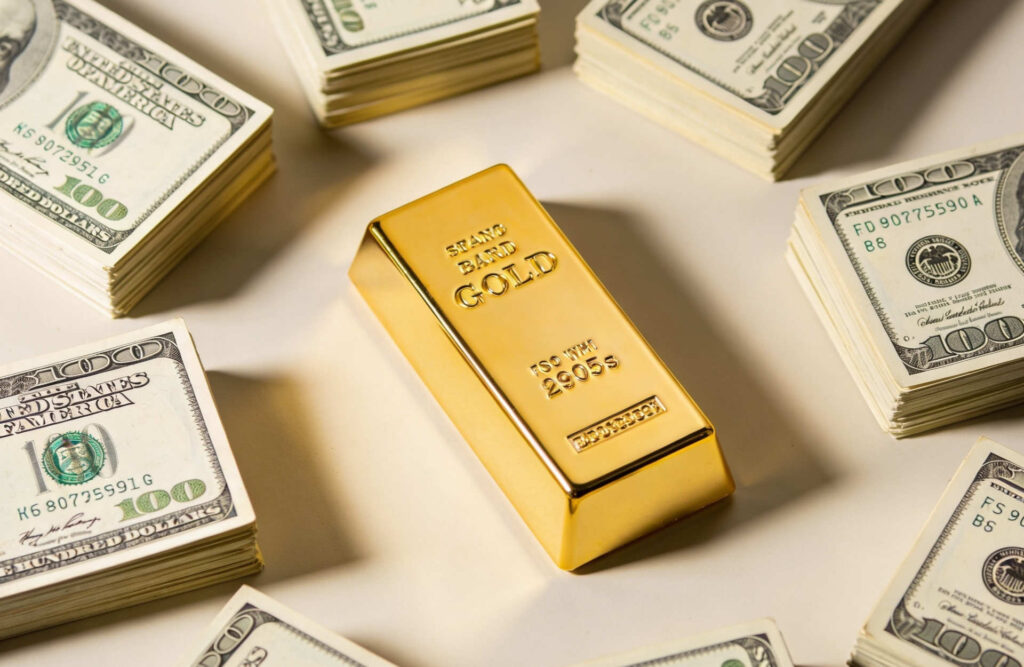
By the summer of 1971, the math had become impossible to ignore. The U.S. was hemorrhaging gold. France, under President Georges Pompidou, had been particularly aggressive in converting dollar reserves to gold — even sending a French warship to New York to physically collect gold bars from the Federal Reserve. On August 15, 1971, President Richard Nixon went on national television and announced that the U.S. would immediately suspend the convertibility of the dollar into gold. The gold standard, in any meaningful form, was dead.
What Forced Nixon to Abandon the Gold Standard
The pressure on Nixon wasn’t political theater — it was arithmetic. By 1971, the U.S. held approximately $10 billion in gold reserves while foreign governments held over $80 billion in dollar claims. The promise to convert dollars to gold at $35 per ounce was, by that point, mathematically impossible to keep. Nixon’s hand was forced not by ideology but by a run on American gold that was accelerating by the week.
The spending pressures of the 1960s had been relentless. The Vietnam War alone cost over $840 billion in today’s dollars, and President Lyndon Johnson’s Great Society programs added enormous domestic expenditures on top of that. Rather than raise taxes to cover the gap, the government expanded the money supply — printing more dollars than gold reserves could honestly support. By the time Nixon inherited the problem, the Bretton Woods framework was already cracking at the foundation.
What Happened to Gold Prices the Moment the Peg Was Cut
The immediate effect of Nixon’s announcement was relatively contained — markets don’t always grasp the full implications of seismic shifts on day one. The official gold price was initially adjusted to $38 per ounce under the short-lived Smithsonian Agreement of December 1971, which Nixon himself called “the most significant monetary agreement in the history of the world.” That agreement lasted less than 14 months before it too collapsed.
Once the Smithsonian Agreement fell apart and the major currencies moved to floating exchange rates in 1973, gold was finally free to find its true market price. What followed was one of the most dramatic price surges in commodity history. Gold moved from $35 in 1971 to over $180 by 1974 — a gain of more than 400% in just three years.
The oil crisis of 1973, triggered by the OPEC embargo, poured fuel on the fire. Inflation spiked, confidence in the dollar eroded, and investors flooded into gold as a safe haven. The combination of a newly untethered dollar and a global energy shock created the perfect conditions for gold to reassert itself as the world’s preferred store of value.
By January 1980, gold reached a then-record high of $850 per ounce — a staggering 2,329% increase from the Bretton Woods fixed rate in less than a decade. The factors that drove that surge were a telling indictment of what happens when monetary discipline disappears:
- Runaway inflation — U.S. inflation hit 13.5% in 1980, the highest since World War II
- Dollar devaluation — the greenback lost purchasing power year after year through the 1970s
- Geopolitical instability — the Soviet invasion of Afghanistan and the Iran hostage crisis drove fear-based gold buying
- Negative real interest rates — inflation outpaced savings rates, making gold more attractive than cash deposits
- Speculative momentum — as gold rose, more buyers entered the market, accelerating the rally
How the Dollar Became a Fiat Currency Overnight
When Nixon closed the gold window, the dollar became what economists call a fiat currency — money that has value purely because the government says it does and because people collectively agree to use it. There is no gold bar in Fort Knox backing the twenty-dollar bill in your wallet. Its value rests entirely on institutional trust, the strength of the U.S. economy, and the dollar’s dominant role in global trade, particularly in oil markets where transactions are still predominantly settled in dollars.
This shift fundamentally changed the rules of monetary policy. Without the discipline of gold convertibility, the Federal Reserve gained the ability to expand the money supply in response to economic conditions — a flexibility that has both cushioned recessions and, critics argue, enabled the long-term inflation that has steadily eroded the dollar’s purchasing power ever since 1971.
Decade-by-Decade: How the Dollar Weakened Against Gold
Tracking gold’s price decade by decade isn’t just an exercise in financial nostalgia — it’s a real-time record of how much purchasing power the dollar has quietly surrendered over time. Each era tells its own story, shaped by wars, recessions, policy decisions, and market forces. But the long-term direction of the trend is unmistakable.
1910s: Gold at $20.67 and What a Dollar Could Buy
In 1910, the dollar was a serious unit of account. With gold fixed at $20.67 per ounce by law, prices across the economy reflected that stability. A pound of steak cost roughly $0.15, a decent men’s suit ran about $10 to $15, and a year’s rent in a modest American city could be covered for under $200. In gold terms, these prices were tiny fractions of a single ounce.
The first real test of the gold standard came with World War I, when the U.S. and European nations temporarily suspended gold convertibility to finance wartime spending. Though the U.S. returned to gold after the war, the episode foreshadowed the fundamental incompatibility between unlimited government spending and a gold-backed monetary system — a tension that would grow more acute with every passing decade.
1960s: Gold at $36.50 as Consumer Prices Begin to Climb
The 1960s looked stable on the surface — gold remained close to the Bretton Woods fixed price of $35 per ounce for most of the decade. But underneath that calm, the seeds of monetary instability were being planted in earnest. The combination of Vietnam War spending and Great Society domestic programs pushed federal deficits higher, expanding the money supply at a pace that gold reserves couldn’t match. Consumer prices began their upward climb, and the dollar started losing ground in real terms even before Nixon officially ended convertibility. A man’s suit that cost $15 in 1910 now runs $50 to $75, priced in dollars, nearly five times more expensive. Priced in gold ounces, the difference was far more modest.
1980s: Gold Surges to $594.90 as Inflation Hammers the Dollar
The average gold price through the 1980s settled around $594.90 per ounce, a reflection of the era’s brutal inflationary environment. Federal Reserve Chairman Paul Volcker’s decision to raise interest rates aggressively — the federal funds rate peaked at 20% in June 1981 — eventually tamed inflation, but the damage to ordinary purchasing power had already been done. The dollar of 1980 bought significantly less than the dollar of 1970, and the gap would only widen.
1990s Through 2000s: Gold Awakens From a Long Sleep
Gold spent most of the 1990s in a prolonged slump, falling as low as $252 per ounce in 1999 as a strong dollar, rising equity markets, and low inflation made the yellow metal look like a relic. Central banks were actually selling gold reserves during this period, viewing it as an unproductive asset in an era of prosperity. But the early 2000s brought a rude awakening — the dot-com bust, the September 11 attacks, the Iraq War, and eventually the 2008 financial crisis collectively shattered confidence in financial institutions and sent gold on a decade-long bull run that took it from $252 in 1999 to nearly $1,900 by 2011.
2020s: Gold Crosses $2,000 While Dollar Purchasing Power Fades
The COVID-19 pandemic triggered the largest peacetime expansion of the U.S. money supply in history. The Federal Reserve slashed interest rates to near zero, and the U.S. government deployed trillions in stimulus spending. Gold crossed $2,000 per ounce for the first time in August 2020, a milestone that would have seemed surreal to anyone who remembered the Bretton Woods era of $35 gold. By 2024, gold was trading above $3,100 per ounce, reflecting a combination of persistent inflation, geopolitical uncertainty, and declining confidence in fiat currency stability.
The numbers below put the entire century-long journey into stark perspective:
| Decade | Avg. Gold Price/oz | U.S. Inflation Rate | Dollar Purchasing Power vs. 1913 |
| 1910s | $20.67 | ~7% (WWI spike) | ~$1.00 |
| 1930s | $33.85 (post-revaluation) | Deflation then recovery | ~$0.70 |
| 1960s | $35.27 | ~2-3% | ~$0.42 |
| 1980s | $594.90 | ~7-13% | ~$0.18 |
| 2000s | $572.00 | ~2-3% | ~$0.10 |
| 2020s | $4,000+ | ~4-9% | ~$0.04 |
What that final column reveals is staggering: a dollar that was worth $1.00 in purchasing power in 1913 is worth approximately four cents in equivalent terms today. Gold, by contrast, has preserved and grown real value across every single one of those decades. That is not a coincidence — it is the mathematical consequence of a fiat monetary system operating without the anchor of a gold standard.
What a Suit, a Steak, and a Car Reveal About Dollar Erosion
Abstract monetary theory becomes concrete fast when you price everyday items in gold instead of dollars. A quality men’s suit cost roughly $20 in 1910 — nearly one full ounce of gold. Today, a comparable suit runs $400 to $600 in dollars, but still costs approximately the same fraction of a gold ounce as it did over a century ago. The steak that cost $0.15 per pound in 1910 now costs $12 to $15 per pound — a 100-fold increase in dollar terms, but a nearly identical cost when measured against gold.
The car that sold for $400 in 1910 (roughly 19 ounces of gold) now sells for $30,000 to $50,000 in dollars — but only 10 to 15 ounces of gold, meaning cars have actually gotten cheaper in real gold terms. These examples don’t just illustrate inflation. They reveal that the dollar has been the variable all along — and gold has been the constant.
How the Same Items Cost More Dollars but Fewer Gold Ounces Over Time
The most revealing way to understand dollar erosion isn’t to look at inflation charts — it’s to price ordinary goods in gold across different decades. When you do that, something remarkable happens: the gold cost of everyday items stays remarkably stable while the dollar cost explodes. A gallon of gasoline cost about $0.25 in 1950, which was roughly 0.007 ounces of gold. Today, that same gallon costs around $3.50 — but still works out to approximately 0.001 ounces of gold. In dollar terms, gas is 14 times more expensive. In gold terms, it’s actually cheaper.
This pattern repeats across nearly every major consumer category — food, housing, clothing, transportation. The dollar figures change dramatically while the gold figures remain surprisingly consistent. That consistency isn’t magic. It’s the natural result of gold’s fixed supply meeting the world’s relatively stable demand for real goods, while the dollar supply has been expanded repeatedly by policy decisions that have nothing to do with economic productivity. The suit, the steak, and the car aren’t getting more expensive in any absolute sense. The dollar measuring them is simply getting smaller.
Why Gold Measures Real Value Better Than the Dollar Alone
A ruler that keeps shrinking is a terrible measuring tool. That’s essentially what the dollar has become since 1971 — a unit of measurement that contracts in value over time, making it genuinely difficult to compare prices, wages, or wealth across decades with any accuracy. Gold, by contrast, maintains a consistent relationship with the real economy because its supply can only grow at the pace of mining output, historically around 1-2% per year — roughly in line with long-term global economic growth.
This is why economists and financial historians frequently price major historical events and assets in gold terms rather than nominal dollars. When you want to know whether housing is truly more expensive than it was in 1970, or whether wages have genuinely improved since 1980, stripping out the dollar distortion by converting to gold ounces gives you a far cleaner comparison. The dollar tells you what something costs today. Gold tells you what it’s worth in a deeper, more durable sense.
That said, gold is not a perfect measure either. It has its own supply and demand dynamics, geopolitical influences, and speculative phases that can temporarily push its price far above or below fundamental value. The 1980 spike to $850 per ounce and the subsequent crash back to $300 by 1985 is a reminder that gold can be volatile in the short term, even as it holds value over long stretches. The key is time horizon — over decades, gold has proven itself a reliable store of value in a way that no fiat currency in history has managed to sustain.
- Gold supply grows at roughly 1-2% annually — closely matching long-term global economic growth, which underpins its stability as a value benchmark
- The dollar has lost over 96% of its 1913 purchasing power — while gold priced in dollars has risen from $20.67 to over $3,100 in the same period
- Everyday goods priced in gold ounces show remarkable price stability across a century, even as their dollar prices have multiplied many times over
- Central banks worldwide still hold gold as a reserve asset — a clear institutional acknowledgment that gold retains real monetary value even in a fiat currency world
- Gold’s 2011 all-time high of nearly $1,900 and its subsequent climb past $4,000 in 2026 both correlated directly with periods of exceptional dollar weakness and inflation. There’s likely more to this upward gold valuation than meets the eye, with the international strife since 9/11 having much to do with it
None of this means gold is a perfect investment or that a return to the gold standard is practical or even desirable, but that’s a moot point. Modern economies seem to require monetary flexibility that a rigid gold peg cannot provide. But as a measuring stick for real value — stripped of political influence, printing press distortions, and policy manipulation — gold has earned its reputation across centuries of financial history as the most honest unit of account humanity has yet devised.
Gold as the Dollar’s Report Card
Every time the gold price rises sharply, it is handing the dollar a failing grade. Every sustained surge in gold — 1971 to 1980, 1999 to 2011, 2018 to today — has coincided with a period of dollar weakness, monetary expansion, geopolitical stress, or collapsing institutional confidence. The inverse relationship is not a coincidence of markets — it is a structural feature of a world where gold remains the implicit benchmark against which all paper currencies are quietly measured.
From $20.67 in 1910 to over $3,100 today, the gold price isn’t telling you that gold has become more valuable. It’s telling you that the dollar has become less so — one decade at a time, one policy decision at a time, one printing press run at a time.
Frequently Asked Questions
The dollar vs. gold relationship spans over a century of monetary history, policy shifts, and economic upheaval. These are the questions that financial history enthusiasts most frequently ask when digging into the topic.
Understanding the answers gives you a foundation for interpreting not just history, but the financial headlines being written right now — because the same forces that drove gold from $35 to $850 in the 1970s are recognizable in the dynamics playing out in today’s markets.
Why did the U.S. abandon the gold standard?
The U.S. abandoned the gold standard because the promise of gold convertibility had become mathematically impossible to keep. By August 1971, the U.S. held approximately $10 billion in gold reserves while foreign governments held over $80 billion in convertible dollar claims. The combination of Vietnam War spending, Great Society domestic programs, and persistent trade deficits had flooded the world with far more dollars than existing gold reserves could back at the fixed rate of $35 per ounce.
President Nixon’s decision on August 15, 1971 — what became known as the Nixon Shock — was the final break. It wasn’t a planned transition to a better system. It was an emergency response to a run on American gold that was accelerating by the week, with France leading the charge by physically redeeming dollar reserves for gold bars. Once convertibility ended, the Bretton Woods system collapsed, major currencies moved to floating exchange rates by 1973, and gold was free to find its true market price for the first time in decades.
What was the price of gold per ounce in 1910?
In 1910, the price of gold was fixed at $20.67 per troy ounce. This wasn’t a market price determined by supply and demand — it was a legal definition established by the U.S. government under the gold standard. The dollar was defined as a specific weight of gold (23.22 grains of pure gold), which made $20.67 the mathematical equivalent of one troy ounce. This fixed price had held essentially unchanged since the 1830s.
That $20.67 figure held firm through World War I, the Roaring Twenties, and into the early 1930s — nearly a full century of gold price stability that is impossible to imagine by modern standards. The rate was only officially changed in 1934 when President Franklin D. Roosevelt revalued gold to $35 per ounce under the Gold Reserve Act, effectively devaluing the dollar by approximately 41% in a single policy move aimed at fighting the Great Depression.
How much has the dollar lost in value since 1971?
Since Nixon ended gold convertibility in 1971, the dollar has lost the vast majority of its purchasing power. A dollar from 1971 is worth approximately 15 to 16 cents in equivalent purchasing power today — meaning it takes roughly six to seven 2024 dollars to buy what one 1971 dollar could purchase. This represents a purchasing power loss of over 85% in just over five decades.
Gold tells the same story from the other direction. At the time of the Nixon Shock, gold was trading at around $40 to $42 per ounce in the newly freed market. By 2024, gold crossed $3,100 per ounce — an increase of roughly 7,500% from those early post-Bretton Woods prices. The dollar didn’t become worthless overnight. It eroded steadily, year after year, through the compounding effects of inflation, monetary expansion, and the structural consequence of removing the gold anchor from the world’s reserve currency.
Is gold still used to back any currencies today?
No major currency in the world today is formally backed by gold. Since the collapse of Bretton Woods and the move to floating exchange rates in the early 1970s, all major global currencies — including the U.S. dollar, the euro, the British pound, the Japanese yen, and the Chinese yuan — are fiat currencies, meaning their value is not tied to any fixed quantity of gold or other commodity. However, many central banks, including the U.S. Federal Reserve, the European Central Bank, and notably China and Russia in recent years, continue to hold substantial gold reserves as part of their foreign exchange portfolios — an implicit acknowledgment that gold retains strategic monetary value even in a fiat currency world.
Why does gold rise when the dollar weakens?
Gold rises when the dollar weakens primarily because gold is priced globally in U.S. dollars. When the dollar loses value against other currencies, it takes more dollars to buy the same ounce of gold — pushing the dollar price of gold higher even if gold’s intrinsic value hasn’t changed at all. This mechanical relationship means that dollar weakness automatically translates into higher gold prices in dollar terms, regardless of any change in physical supply or demand for gold itself.
Beyond the mechanical currency effect, there is also a deeper psychological and economic dynamic at work. When the dollar weakens, it typically signals — or is caused by — conditions such as rising inflation, lower real interest rates, excessive money supply growth, or eroding confidence in U.S. fiscal management. All of these conditions simultaneously make gold more attractive as a store of value, driving additional investment demand that pushes prices even higher.
Real interest rates play a particularly important role in this relationship. When inflation-adjusted returns on cash and bonds turn negative — meaning inflation is running higher than the interest rate earned on savings — investors have little incentive to hold dollars and a strong incentive to hold gold, which holds purchasing power without carrying the risk of currency debasement. The 1970s, the post-2008 period, and the 2020-2022 inflation surge all featured significantly negative real interest rates, and all three periods coincided with major gold bull markets.
Central bank behavior amplifies the effect further. When major central banks — particularly the Federal Reserve — cut interest rates or expand their balance sheets through quantitative easing, they increase the supply of dollars in circulation. More dollars chasing the same amount of goods and assets pushes inflation higher and the dollar lower, both of which are rocket fuel for gold. The record money supply expansion during the COVID-19 pandemic is a textbook example: the Fed’s balance sheet grew from roughly $4 trillion to over $9 trillion between 2020 and 2022, and gold responded by breaking $2,000 per ounce for the first time in history.
The bottom line is this: gold doesn’t need a weak dollar to have value, but a weak dollar reliably sends gold higher — because in a world of fiat currencies, gold remains the one monetary asset that no government can print, devalue, or talk down with a press release. That irreplaceable scarcity is why the dollar vs. gold story isn’t a relic of financial history. It’s still being written today. For those looking to understand where gold fits in a modern portfolio or to explore the long history of gold as a monetary asset, the U.S. Gold Bureau offers resources and expertise to help investors navigate that conversation with confidence.